


Page 770 - Engineering Digital Design
P. 770
736         CHAPTER 14/ASYNCHRONOUS STATE MACHINE DESIGN AND ANALYSIS


                                     S+T
                    Sanity

                                                          \ST          '         I
                                                          Q,X 00    01   11   10    P   Q


                                                   ST

                                                                                        ST

                                                                                   ST
                                                               •• S      " /  ^~~/
                                                     S+T


                                    (a)                                     (b)

                    FIGURE 14.39
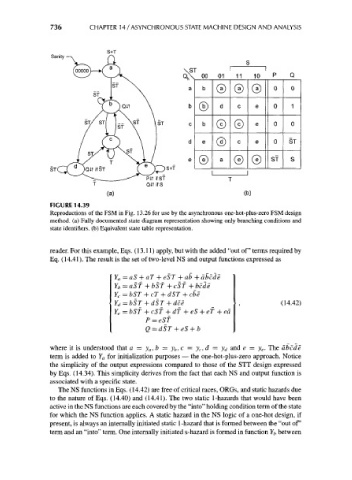
                    Reproductions of the FSM in Fig. 13.26 for use by the asynchronous one-hot-plus-zero FSM design
                    method, (a) Fully documented state diagram representation showing only branching conditions and
                    state identifiers, (b) Equivalent state table representation.


                    reader. For this example, Eqs. (13.11) apply, but with the added "out of" terms required by
                    Eq. (14.41). The result is the set of two-level NS and output functions expressed as

                                       Y a = aS + aT + eST + ab + abode
                                       Y b=aST + bST + cST + bcde
                                       Y c = bST +cT + dST + cbe
                                                                                      (14.42)
                                       Y e = bST + cST + dT + eS + eT + ea
                                                 = eST
                                                 = dST + eS + b

                    where it is understood that a = y a,b — y/,, c = y c,d = y d and e = y e. The abode
                    term is added to Y a for initialization purposes — the one-hot-plus-zero approach. Notice
                    the simplicity of the output expressions compared to those of the STT design expressed
                    by Eqs. (14.34). This simplicity derives from the fact that each NS and output function is
                    associated with a specific state.
                       The NS functions in Eqs. (14.42) are free of critical races, ORGs, and static hazards due
                    to the nature of Eqs. (14.40) and (14.41). The two static 1-hazards that would have been
                    active in the NS functions are each covered by the "into" holding condition term of the state
                    for which the NS function applies. A static hazard in the NS logic of a one-hot design, if
                    present, is always an internally initiated static 1-hazard that is formed between the "out of"
                    term and an "into" term. One internally initiated s-hazard is formed in function Yb between

