


Page 765 - Engineering Digital Design
P. 765
14.13 HAZARD-FREE DESIGN OF FUNDAMENTAL MODE STATE MACHINES         731


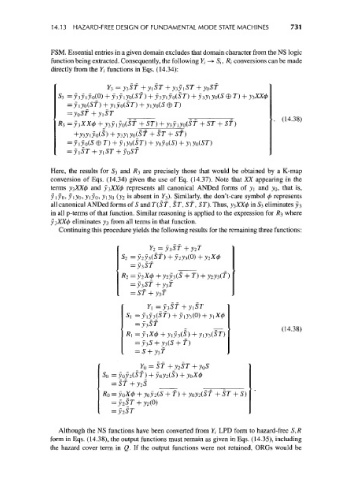
                 FSM. Essential entries in a given domain excludes that domain character from the NS logic
                 function being extracted. Consequently, the following F/ — > 5,- , RI conversions can be made
                 directly from the Y, functions in Eqs. (14.34):


                                  FS = y^ST + y\ST + y 3y\ST + yoST
                    S3 = J3jiyo(0) + y3yiy_o(ST) + y3y\yo(ST) + yiyiyo(S © T) + y 3XX(f>
                      = y\yo(ST)+_yiy 0(ST) + yiyo(S<& T)
                      = yoSf+ yiST
                                                                                   (14 38)
                    ^3 = y 3XX(f> -\- y 3y \yo(ST 4~ ST) -\- y 3y \yo(ST -I- ST + ST)  '
                        +yiy\yo(S) + yiyiyotf  + ST + ST)
                      = y~}yo(S © T) + yiy 0(ST) + yiyo(S) + yiyo(ST)


                 Here, the results for ^3 and ^3 are precisely those that would be obtained by a K-map
                 conversion of Eqs. (14.34) given the use of Eq. (14.37). Note that XX appearing in the
                 terms y^XXcf) and y^XXcj) represents all canonical ANDed forms of y\ and yo, that is,
                 y\yo, Ji Jo» y\yo, y\yo (j2 is absent in FS). Similarly, the don't-care symbol 0 represents
                 all canonical ANDed forms of S and T(S f , S T, ST , ST). Thus, ^3^X0 in S 3 eliminates y  3
                 in all p-terms of that function. Similar reasoning is applied to the expression for RT, where
                 y iXXQ eliminates ^3 from all terms in that function.
                    Continuing this procedure yields the following results for the remaining three functions:

                                                       +y 2T


                                      R 2 = y 2X$ + y 2y_ 3(S + T) + y 2 y 3 (f)
                                        = y 3Sf +y_ 3f
                                        = ST

                                             Fi = y_ 3ST +y }ST
                                       Si =y l_
                                         = y 3ST
                                                                                   (14.38)
                                                 _
                                         = S + y 3f


                                     _
                                   = Sf+y 2S       _
                                 O = y 0X(f> + y 0y 2(S + f ) + y 0y 2(ST + ST +
                                   = y2ST + y 2(0)
                                   = y 2ST


                    Although the NS functions have been converted from F/ LPD form to hazard-free S,R
                 form in Eqs. (14.38), the output functions must remain as given in Eqs. (14.35), including
                 the hazard cover term in Q. If the output functions were not retained, ORGs would be

