


Page 173 - Fluid Mechanics and Thermodynamics of Turbomachinery
P. 173
154 Fluid Mechanics, Thermodynamics of Turbomachinery
D 0.084 and this
Thus, the overall drag coefficient, C D D C D p C C D a C C D s
applies to each row of blades. If the reaction had been other than 0.5 the drag
coefficients for each blade row would have been computed separately.
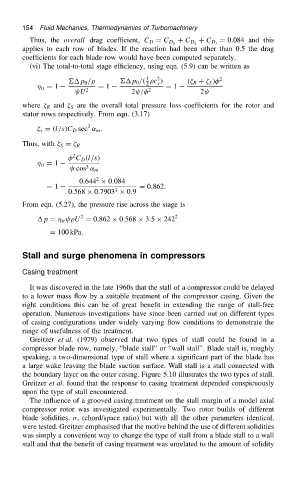
(vi) The total-to-total stage efficiency, using eqn. (5.9) can be written as
1
2
p 0 / p 0 /. c / . R C S / 2
x
2
tt D 1 D 1 D 1
U 2 2 / 2 2
where R and S are the overall total pressure loss coefficients for the rotor and
stator rows respectively. From eqn. (3.17)
3
s D .l/s/C D sec ˛ m .
Thus, with S D R
2
C D .l/s/
tt D 1
3
cos ˛ m
2
0.644 ð 0.084
D 1 D 0.862.
3
0.568 ð 0.7903 ð 0.9
From eqn. (5.27), the pressure rise across the stage is
2
p D tt U D 0.862 ð 0.568 ð 3.5 ð 242 2
D 100 kPa.
Stall and surge phenomena in compressors
Casing treatment
It was discovered in the late 1960s that the stall of a compressor could be delayed
to a lower mass flow by a suitable treatment of the compressor casing. Given the
right conditions this can be of great benefit in extending the range of stall-free
operation. Numerous investigations have since been carried out on different types
of casing configurations under widely varying flow conditions to demonstrate the
range of usefulness of the treatment.
Greitzer et al. (1979) observed that two types of stall could be found in a
compressor blade row, namely, “blade stall” or “wall stall”. Blade stall is, roughly
speaking, a two-dimensional type of stall where a significant part of the blade has
a large wake leaving the blade suction surface. Wall stall is a stall connected with
the boundary layer on the outer casing. Figure 5.10 illustrates the two types of stall.
Greitzer et al. found that the response to casing treatment depended conspicuously
upon the type of stall encountered.
The influence of a grooved casing treatment on the stall margin of a model axial
compressor rotor was investigated experimentally. Two rotor builds of different
blade solidities, , (chord/space ratio) but with all the other parameters identical,
were tested. Greitzer emphasised that the motive behind the use of different solidities
was simply a convenient way to change the type of stall from a blade stall to a wall
stall and that the benefit of casing treatment was unrelated to the amount of solidity

