


Page 175 - Fluid Mechanics and Thermodynamics of Turbomachinery
P. 175
156 Fluid Mechanics, Thermodynamics of Turbomachinery
1.0
grooved casing
smooth casing
s = 2
Dp/(½rU 2 ) 0.8 s = 1
0.6
0.6 0.8 1.0
f = c /U
x
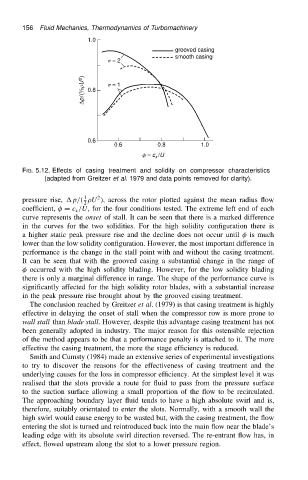
FIG. 5.12. Effects of casing treatment and solidity on compressor characteristics
(adapted from Greitzer et al. 1979 and data points removed for clarity).
2
1
pressure rise, p/. U /, across the rotor plotted against the mean radius flow
2
coefficient, D c x /U, for the four conditions tested. The extreme left end of each
curve represents the onset of stall. It can be seen that there is a marked difference
in the curves for the two solidities. For the high solidity configuration there is
a higher static peak pressure rise and the decline does not occur until is much
lower than the low solidity configuration. However, the most important difference in
performance is the change in the stall point with and without the casing treatment.
It can be seen that with the grooved casing a substantial change in the range of
occurred with the high solidity blading. However, for the low solidity blading
there is only a marginal difference in range. The shape of the performance curve is
significantly affected for the high solidity rotor blades, with a substantial increase
in the peak pressure rise brought about by the grooved casing treatment.
The conclusion reached by Greitzer et al. (1979) is that casing treatment is highly
effective in delaying the onset of stall when the compressor row is more prone to
wall stall than blade stall. However, despite this advantage casing treatment has not
been generally adopted in industry. The major reason for this ostensible rejection
of the method appears to be that a performance penalty is attached to it. The more
effective the casing treatment, the more the stage efficiency is reduced.
Smith and Cumsty (1984) made an extensive series of experimental investigations
to try to discover the reasons for the effectiveness of casing treatment and the
underlying causes for the loss in compressor efficiency. At the simplest level it was
realised that the slots provide a route for fluid to pass from the pressure surface
to the suction surface allowing a small proportion of the flow to be recirculated.
The approaching boundary layer fluid tends to have a high absolute swirl and is,
therefore, suitably orientated to enter the slots. Normally, with a smooth wall the
high swirl would cause energy to be wasted but, with the casing treatment, the flow
entering the slot is turned and reintroduced back into the main flow near the blade’s
leading edge with its absolute swirl direction reversed. The re-entrant flow has, in
effect, flowed upstream along the slot to a lower pressure region.

