


Page 177 - Fluid Mechanics and Thermodynamics of Turbomachinery
P. 177
158 Fluid Mechanics, Thermodynamics of Turbomachinery


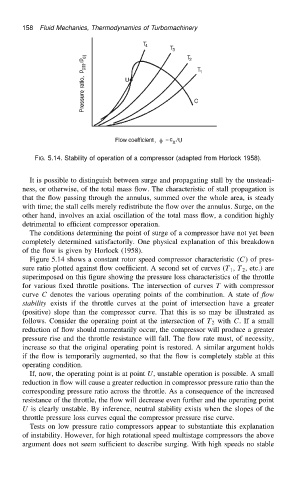
                             FIG. 5.14. Stability of operation of a compressor (adapted from Horlock 1958).


                            It is possible to distinguish between surge and propagating stall by the unsteadi-
                          ness, or otherwise, of the total mass flow. The characteristic of stall propagation is
                          that the flow passing through the annulus, summed over the whole area, is steady
                          with time; the stall cells merely redistribute the flow over the annulus. Surge, on the
                          other hand, involves an axial oscillation of the total mass flow, a condition highly
                          detrimental to efficient compressor operation.
                            The conditions determining the point of surge of a compressor have not yet been
                          completely determined satisfactorily. One physical explanation of this breakdown
                          of the flow is given by Horlock (1958).
                            Figure 5.14 shows a constant rotor speed compressor characteristic .C/ of pres-
                          sure ratio plotted against flow coefficient. A second set of curves (T 1 , T 2 , etc.) are
                          superimposed on this figure showing the pressure loss characteristics of the throttle
                          for various fixed throttle positions. The intersection of curves T with compressor
                          curve C denotes the various operating points of the combination. A state of flow
                          stability exists if the throttle curves at the point of intersection have a greater
                          (positive) slope than the compressor curve. That this is so may be illustrated as
                          follows. Consider the operating point at the intersection of T 2 with C. If a small
                          reduction of flow should momentarily occur, the compressor will produce a greater
                          pressure rise and the throttle resistance will fall. The flow rate must, of necessity,
                          increase so that the original operating point is restored. A similar argument holds
                          if the flow is temporarily augmented, so that the flow is completely stable at this
                          operating condition.
                            If, now, the operating point is at point U, unstable operation is possible. A small
                          reduction in flow will cause a greater reduction in compressor pressure ratio than the
                          corresponding pressure ratio across the throttle. As a consequence of the increased
                          resistance of the throttle, the flow will decrease even further and the operating point
                          U is clearly unstable. By inference, neutral stability exists when the slopes of the
                          throttle pressure loss curves equal the compressor pressure rise curve.
                            Tests on low pressure ratio compressors appear to substantiate this explanation
                          of instability. However, for high rotational speed multistage compressors the above
                          argument does not seem sufficient to describe surging. With high speeds no stable

