


Page 179 - Fluid Mechanics and Thermodynamics of Turbomachinery
P. 179
160 Fluid Mechanics, Thermodynamics of Turbomachinery
                                                High-pressure
                                                air source
                                                                 Adjustable
                                                                 dashpot
                            Injection
                            plenum
                            Valve area detemined
                            by tip deflection of  Reed           Cantilevered
                            reed valve          seal             reed valve

                                                                                           Tip


                                                           Injection flow
                                                                                  Rotor
                                         Air flow to compressor
                                                                                          Hub


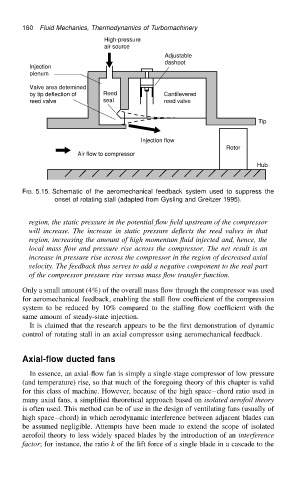
                          FIG. 5.15. Schematic of the aeromechanical feedback system used to suppress the
                                   onset of rotating stall (adapted from Gysling and Greitzer 1995).

                            region, the static pressure in the potential flow field upstream of the compressor
                            will increase. The increase in static pressure deflects the reed valves in that
                            region, increasing the amount of high momentum fluid injected and, hence, the
                            local mass flow and pressure rise across the compressor. The net result is an
                            increase in pressure rise across the compressor in the region of decreased axial
                            velocity. The feedback thus serves to add a negative component to the real part
                            of the compressor pressure rise versus mass flow transfer function.

                          Only a small amount (4%) of the overall mass flow through the compressor was used
                          for aeromechanical feedback, enabling the stall flow coefficient of the compression
                          system to be reduced by 10% compared to the stalling flow coefficient with the
                          same amount of steady-state injection.
                            It is claimed that the research appears to be the first demonstration of dynamic
                          control of rotating stall in an axial compressor using aeromechanical feedback.


                          Axial-flow ducted fans
                            In essence, an axial-flow fan is simply a single-stage compressor of low pressure
                          (and temperature) rise, so that much of the foregoing theory of this chapter is valid
                          for this class of machine. However, because of the high space chord ratio used in
                          many axial fans, a simplified theoretical approach based on isolated aerofoil theory
                          is often used. This method can be of use in the design of ventilating fans (usually of
                          high space chord) in which aerodynamic interference between adjacent blades can
                          be assumed negligible. Attempts have been made to extend the scope of isolated
                          aerofoil theory to less widely spaced blades by the introduction of an interference
                          factor; for instance, the ratio k of the lift force of a single blade in a cascade to the

