


Page 293 - Fundamentals of Reservoir Engineering
P. 293
OILWELL TESTING                                    229

                     In practice, the value of F is seldom explicitly calculated in the McKinley analysis. It is a
                     parameter which disappears by cancellation when calculating the wellbore
                     transmissibility.

                     Each type curve is characterised by a fixed value of T/F, where T is the transmissibility
                     = kh/µ mD.ft/cp.

                     The steps involved in a McKinley analysis, which is usually aimed at determining
                     transmissibilities in the damaged/stimulated zone close to the wellbore, and the
                     average for the formation away from the well, are as follows.
                     a)   Make a table of values of ∆t, the closed in time (minutes), and the corresponding
                           values of ∆p = p ws (∆t) - p wf (t) (psi). Unlike the Russell method it is not necessary
                           to differentiate between the part of the buildup due to skin and that due to
                           afterflow, all values of ∆t and ∆p can be used.

                     b)   Overlay the McKinley chart with a sheet of transparent paper and draw vertical
                           and horizontal axes to match those of the chart. The ordinate should have the
                           same log time scale as the McKinley chart but the abscissa, while using the
                           same log scale, should be plotted for the most suitable range of pressure values.
                           Plot the ∆t versus ∆p data on this transparent paper.

                     c)   The transparent paper is then moved laterally over the McKinley chart, keeping
                           the abscissae together, until the early part of the pressure buildup coincides with
                           one of the type curves.

                     d)   The value of the parameter T/F, characterising the type curve for which the match
                           is obtained, is noted.
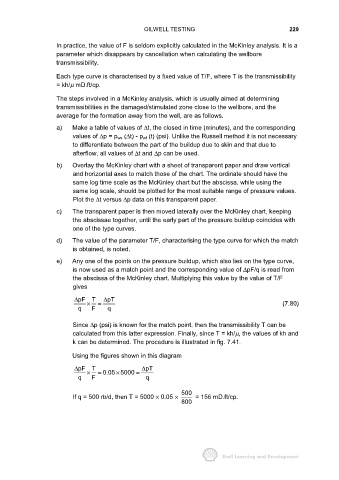
                     e)   Any one of the points on the pressure buildup, which also lies on the type curve,
                           is now used as a match point and the corresponding value of ∆pF/q is read from
                           the abscissa of the McKinley chart. Multiplying this value by the value of T/F
                           gives

                           ∆ pF  T   ∆ pT
                                ×  =                                                                (7.80)
                            q    F     q

                           Since ∆p (psi) is known for the match point, then the transmissibility T can be
                           calculated from this latter expression. Finally, since T = kh/µ, the values of kh and
                           k can be determined. The procedure is illustrated in fig. 7.41.

                          Using the figures shown in this diagram

                           ∆ pF  T                 ∆ pT
                                          ×
                                ×  =  0.05 5000 =
                            q    F                  q
                                                                 500
                           If q = 500 rb/d, then T = 5000 × 0.05 ×    = 156 mD.ft/cp.
                                                                 800

