


Page 168 - Fundamentals of Water Treatment Unit Processes : Physical, Chemical, and Biological
P. 168
Sedimentation                                                                                    123


                                                               Shear force       Shear force


                                                      mgcosθ       (c) mgcosθ
                                             θ
                              (a)                 (b)         mg

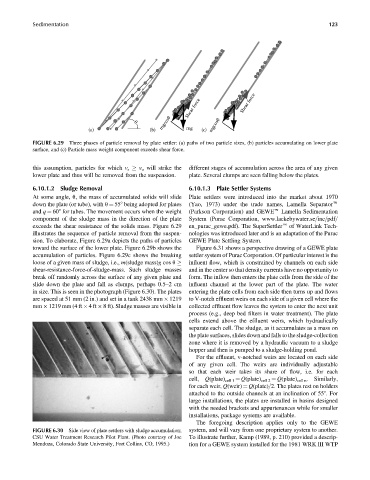
            FIGURE 6.29  Three phases of particle removal by plate settler: (a) paths of two particle sizes, (b) particles accumulating on lower plate
            surface, and (c) Particle mass weight component exceeds shear force.


            this assumption, particles for which v s   v o will strike the  different stages of accumulation across the area of any given
            lower plate and thus will be removed from the suspension.  plate. Several clumps are seen falling below the plates.
            6.10.1.2  Sludge Removal                           6.10.1.3  Plate Settler Systems
            At some angle, u, the mass of accumulated solids will slide  Plate settlers were introduced into the market about 1970
            down the plate (or tube), with u ¼ 558 being adopted for plates  (Yao, 1973) under the trade names, Lamella Separatore
            and q ¼ 608 for tubes. The movement occurs when the weight  (Parkson Corporation) and GEWEe Lamella Sedimentation
            component of the sludge mass in the direction of the plate  System (Purac Corporation, www.lackebywater.se=inc=pdf=
            exceeds the shear resistance of the solids mass. Figure 6.29  en_purac_gewe.pdf). The SuperSettlere of WaterLink Tech-
            illustrates the sequence of particle removal from the suspen-  nologies was introduced later and is an adaptation of the Purac
            sion. To elaborate, Figure 6.29a depicts the paths of particles  GEWE Plate Settling System.
            toward the surface of the lower plate. Figure 6.29b shows the  Figure 6.31 shows a perspective drawing of a GEWE plate
            accumulation of particles. Figure 6.29c shows the breaking  settler system of Purac Corporation. Of particular interest is the
                                                               influent flow, which is constrained by channels on each side
            loose of a given mass of sludge, i.e., m(sludge mass)g cos u
            shear-resistance-force-of-sludge-mass. Such sludge masses  and in the center so that density currents have no opportunity to
            break off randomly across the surface of any given plate and  form. The inflow then enters the plate cells from the side of the
            slide down the plate and fall as clumps, perhaps 0.5–2cm  influent channel at the lower part of the plate. The water
            in size. This is seen in the photograph (Figure 6.30). The plates  entering the plate cells from each side then turns up and flows
            are spaced at 51 mm (2 in.) and set in a tank 2438 mm   1219  to V-notch effluent weirs on each side of a given cell where the
            mm   1219 mm (4 ft   4ft   8 ft). Sludge masses are visible in  collected effluent flow leaves the system to enter the next unit
                                                               process (e.g., deep bed filters in water treatment). The plate
                                                               cells extend above the effluent weirs, which hydraulically
                                                               separate each cell. The sludge, as it accumulates as a mass on
                                                               the plate surfaces, slides down and falls to the sludge-collection
                                                               zone where it is removed by a hydraulic vacuum to a sludge
                                                               hopper and then is pumped to a sludge-holding pond.
                                                                  For the effluent, v-notched weirs are located on each side
                                                               of any given cell. The weirs are individually adjustable
                                                               so that each weir takes its share of flow, i.e. for each
                                                               cell, Q(plate) cell 1 ¼ Q(plate) cell 2 ¼ Q(plate) cell n . Similarly,
                                                               for each weir, Q(weir) ¼ Q(plate)=2. The plates rest on holders
                                                               attached to the outside channels at an inclination of 558. For
                                                               large installations, the plates are installed in basins designed
                                                               with the needed brackets and appurtenances while for smaller
                                                               installations, package systems are available.
                                                                  The foregoing description applies only to the GEWE
            FIGURE 6.30 Side view of plate settlers with sludge accumulation;  system, and will vary from one proprietary system to another.
            CSU Water Treatment Research Pilot Plant. (Photo courtesy of Joe  To illustrate further, Kamp (1989, p. 210) provided a descrip-
            Mendoza, Colorado State University, Fort Collins, CO, 1995.)  tion for a GEWE system installed for the 1981 WRK III WTP

