


Page 217 - Glucose Monitoring Devices
P. 217
220    CHAPTER 11 Retrofitting CGM traces


                         studies testing we conducted in 2012e14 [11e14], offering a relatively large
                         number of highly accurate references (YSI) to retrospectively the CGM.
                            Then, in section Retrofitting real-life adjunctive data, we show that the retrofit-
                         ting method is capable also to improve the accuracy of a newer and more accurate
                         Dexcom sensor (Dexcom G5) that reached the 1-digit precision (currently one of the
                         most accurate CGMs on the market) with data collected in real-life conditions.
                            Finally, in section Accuracy of retrofitted CGM versus number of references
                         available, we investigate how the accuracy improvement granted by the retrofitting
                         method is affected by the number of BG measurement available.


                         The retrofitting algorithm
                         Problem formulation
                         The retrofitting method reconstructs, with high temporal resolution, BG concentra-
                         tion profile, bgðtÞ from CGM records, cgmðtÞ, i.e., measurements of the interstitial
                         glucose concentration affected by noise and bias due to lack/loss of calibration. The
                         method has also access to a few sparse but accurate BG reference measurements.
                         Moreover, we assume that CGM calibration times are known. The signals bgðtÞ
                         and cgmðtÞ are related by the model in Fig. 11.1 . The first block models the glucose
                         transport between blood and interstitial fluid with a two-compartment model
                         [15,16],
                                                 d
                                                s  igðtÞ¼   igðtÞþ bgðtÞ               (11.1)
                                                 dt
                         where igðtÞ is the interstitial fluid glucose concentration and s is the diffusion time
                         constant assumed to remain constant between two consecutive calibrations. CGM
                         sensor measures glucose in the interstitial fluid producing a current signal, converted
                         back to a glucose concentration by calibration. Due to uncertainties in the calibration
                         process and to transduction sensitivity drifts, for sake of simplicity referred to as
                                                 Pre−processing Step: Outlier Detection
                           400                       (Input) Raw CGM
                                                     (Input) Raw BG References
                           350                       (Output) Outlier Free Signals
                          Concentration [mg/dl]  250
                                                     Test BG Reference
                           300
                           200
                           150
                                Unreliable                                        Spike
                           100
                                Reference
                                                      Repeated   Pressure Induced
                            50                        Measurment   Sensitivity Loss
                            18:00          00:00          06:00          12:00          18:00
                                                        Time [hh:mm]
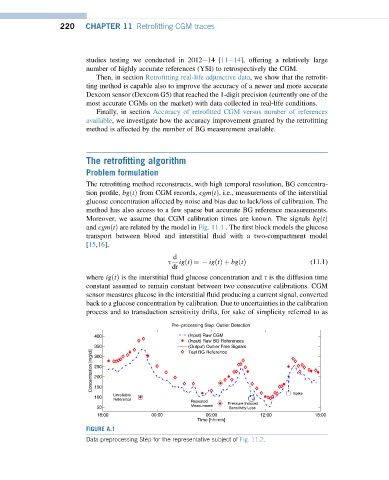
                         FIGURE A.1
                         Data preprocessing Step for the representative subject of Fig. 11.2.

