


Page 258 - Handbook of Civil Engineering Calculations, Second Edition
P. 258
REINFORCED CONCRETE                  2.43

                              7. Design the reinforcement
                              In Fig. 24, EA   3.00 ft (0.914 m); V EF   380(3.00/7.67)   148.6 kips (666.97 kN); M EF
                                  1
                              148.6( /2)(3.00)(12)   2675 in.·kips (302.22 kN·m); A s   2675/[20(0.874)(19.5)]   7.85 sq.in.
                                                                                   2
                                      2
                              (50.648 cm ). Try 10 no. 8 bars each way. Then A s   7.90 sq.in. (50.971 cm );  o   31.4 in.
                              (797.56 mm); u   V EF / ojd   148,600/[31.4(0.874)(19.5)]   278 lb/sq.in. (1916.81 kPa);
                              u allow   264/1   264 lb/sq.in. (1820.3 kPa).
                                The bond stress at EF is slightly excessive. However, the ACI Code, in sections based
                              on ultimate-strength considerations, permits disregarding the local bond stress if the aver-
                              age bond stress across the length of embedment is less than 80 percent of the allowable
                              stress. Let L e denote this length. Then L e   EA   3   33 in. (838.2 mm); 0.80u allow
                              211 lb/sq.in. (1454.8 kPa); u av   A s f s /(L e  o)   0.79(20,000)/[33(3.1)]   154 lb/sq.in.
                              (1061.8 kPa). This is acceptable.
                              8. Design the dowels to comply with the Code
                              The function of the dowels is to transfer the compressive force in the column reinforcing
                              bars to the footing. Since this is a tied column, assume the stress in the bars is 0.85(20,000)
                              17,000 lb/sq.in. (117,215.0 kPa). Try eight no. 9 dowels with  f y   40,000 lb/sq.in.
                              (275,800.0 kPa). Then u   264/(9/8)   235 lb/sq.in. (1620.3 kPa); L e   1.00(17,000)/
                              [235(3.5)]   20.7 in. (525.78 mm). Since
                              the footing can provide a 21-in. (533.4-
                              mm) embedment length, the dowel selec-
                              tion is satisfactory. Also, the length of
                              lap    20(9/8)    22.5 in. (571.5 mm);
                              length of dowels   20.7   22.5   43.2,
                              say 44 in. (1117.6 mm). The footing is
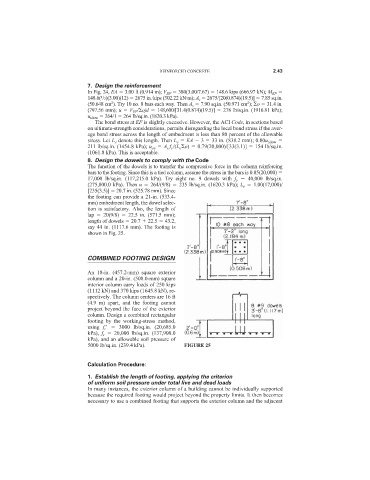
                              shown in Fig. 25.


                              COMBINED FOOTING DESIGN

                              An 18-in. (457.2-mm) square exterior
                              column and a 20-in. (508.0-mm) square
                              interior column carry loads of 250 kips
                              (1112 kN) and 370 kips (1645.8 kN), re-
                              spectively. The column centers are 16 ft
                              (4.9 m) apart, and the footing cannot
                              project beyond the face of the exterior
                              column. Design a combined rectangular
                              footing by the working-stress method,
                              using  f c
  3000 lb/sq.in. (20,685.0
                              kPa),  f s   20,000 lb/sq.in. (137,900.0
                              kPa), and an allowable soil pressure of
                              5000 lb/sq.in. (239.4 kPa).     FIGURE 25


                              Calculation Procedure:
                              1. Establish the length of footing, applying the criterion
                              of uniform soil pressure under total live and dead loads
                              In many instances, the exterior column of a building cannot be individually supported
                              because the required footing would project beyond the property limits. It then becomes
                              necessary to use a combined footing that supports the exterior column and the adjacent

