


Page 529 - Industrial Power Engineering and Applications Handbook
P. 529
Captive (emergency) power generation  16/503
         through the armature windings when the two machines               r---------~~~~~~~~-
                                                                                      QDC
         are operating in parallel (Figure  16.21), or controls the             Control          I
         reactive  component  within  the  required  limits  when             transformer        I
         operating on an infinite bus (Figure 16.26(a)). The limit
         of such circulating currents is defined to be within 5% of
         the  rated  current  of  the  machine.  The  QDC circuit  is
         illustrated in Figure 16.6. The basic purpose of the circuit
         is to detect the content of kVAr being fed by the machine
         when operating in parallel. The AVR, in turn, adjusts the
         field excitation to vary the operating p.f. of the machine
         to control the kVAr to the required level.
          If  the  machine  operates  at p.f.s  lower  than  0.8, the
         excitation  requirement  of  the  machine  would  be high.
         This  is  a  case  of  overexcitation  and  may  damage  the      -
         field  system.  For  such operations,  the  machine  would   I                        I
         require  a  double  derating, depending  upon  the  p.f.  at
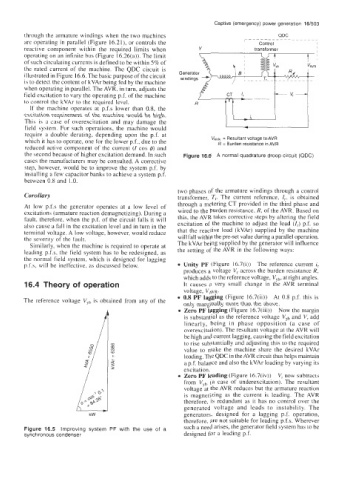
         which it has to operate, one for the lower p.f., due to the   VnvR  = Resultant voltage to AVR
                                                                   R = Burden resistance in AVR
         reduced  active component of  the current (I cos 4)  and
         the second because of higher excitation demand. In such   Figure 16.6  A  normal quadrature droop circuit (QDC)
         cases the manufacturers may be consulted. A corrective
         step, however, would be to improve the system p.f. by
         installing a few capacitor banks to achieve a system p.f.
         between 0.8 and  1.0.
                                                       two phases of the armature windings through a control
         Corollary                                     transformer,  T,. The  current  reference,  I,,  is  obtained
         At  low  p.f.s  the  generator  operates  at  a  low  level  of   through a metering CT provided in the third  phase and
         excitations (armature reaction demagnetizing). During a   wired to the burden resistance, R, of the AVR. Based on
         fault, therefore, when the p.f. of  the circuit falls it will   this, the AVR takes corrective steps by altering the field
         also cause a fall in the excitation level and in turn in the   excitation of the machine to adjust the load (I,)  p.f. so
         terminal voltage. A low voltage, however, would reduce   that the reactive load  (kVAr)  supplied by  the  machine
         the severity of the fault.                    will fall within the pre-set value during a parallel operation.
          Similarly, when the machine is required to operate at   The kVAr being supplied by the generator will influence
         leading p.f.s, the field  system has to be redesigned,  as   the setting of  the AVR  in the following ways:
         the normal field system, which is designed for lagging
         p.f.s, will  be ineffective, as discussed below.   Unity  PF  (Figure  16.7(i))  The reference current i,
                                                         produces a voltage V, across the burden resistance R,
                                                         which adds to the reference voltage, VYb, at right angles.
         16.4 Theory of operation                        It  causes  a  very  small  change  in  the AVR  terminal
                                                         voltage, V,,,.
                                                         0.8 PF lagging  (Figure  16.7(ii))  At  0.8 p.f.  this is
        The reference  voltage  Vyh is obtained from  any  of  the
                                                         only marginally more than the above.
                                                         Zero PF lagging (Figure 16.7(iii))  Now the margin
                                                         is substantial as the reference voltage VYb and V, add
                                                         linearly,  being  in  phase  opposition  (a  case  of
                                                         overexcitation). The resultant voltage at the AVR will
                                                         be high and current lagging, causing the field excitation
                                                         to rise substantially and adjusting this to the required
                                                         value  to  make  the  machine  share  the  desired  kVAr
                                                         loading. The QDC in the AVR circuit thus helps maintain
                                                         a p.f. balance and also the kVAr loading by varying its
                                                         excitation.
                                                         Zero PF leading (Figure 16.7(iv))  V, now subtracts
                                                         from  VYb (a  case  of  underexcitation).  The  resultant
                                                         voltage at the AVR reduces but the armature reaction
                                                         is  magnetizing  as  the  current  is  leading.  The  AVR
                                                         therefore, is redundant as it has no control over the
                                                         generated  voltage  and  leads  to  instability.  The
                                                         generators,  designed  for  a  lagging  p.f.  operation,
                                                         therefore, are not suitable for leading p.f.s. Wherever
         Figure  16.5  Improving  system  PF  with  the  use  of  a   such a need arises, the generator field system has to be
         synchronous  condenser                          designed for a leading p.f.

