


Page 677 - Industrial Power Engineering and Applications Handbook
P. 677
19/642 Industrial Power Engineering and Applications  Handbook
                                                     such a breaker, provided with a magnetic coil. The breakers
                                                     based on this principle are known as rotating arc circuit
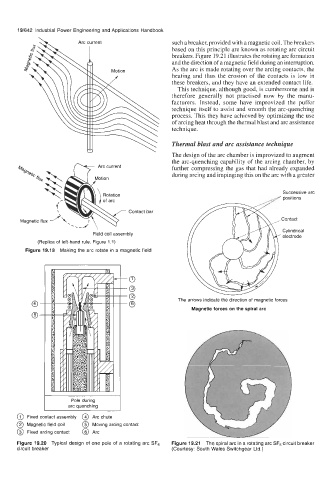
                                                     breakers. Figure 19.21 illustrates the rotating arc formation
                                                     and the direction of a magnetic field during an interruption.
                                                     As the arc is made rotating over the arcing contacts, the
                                                     heating  and thus  the erosion of  the  contacts  is  low in
                                                     these breakers, and they have an extended contact life.
                                                       This technique, although good, is cumbersome and is
                                                     therefore  generally  not  practised  now  by  the  manu-
                                                     facturers.  Instead,  some  have  improvized  the  puffer
                                                     technique  itself to assist and smooth the arc-quenching
                                                     process. This they have achieved by  optimizing the use
                                                     of arcing heat through the thermal blast and arc assistance
                                                     technique.
                                                     Thermal blast and arc assistance technique

                                                     The design of the arc chamber is improvized to augment
                                                     the arc-quenching  capability  of the arcing chamber, by
                                                     further compressing  the gas that had already expanded
                                                     during arcing and impinging this on the arc with a greater


                                                                                       Successive arc
                                                                                       positions
                                        Contact bar


                                                                                       Cylindrical
                             Field coil assembly                                     ’ electrode
             (Replica of left-hand rule, Figure 1.1)
         Figure 19.19  Making the arc rotate in a magnetic field


           0-                                          The arrows indicate the direction of magnetic forces
                                                           Magnetic forces on the spiral arc
           0-


                       Pole during   I
                      arc quenching
      @  Fixed contact assembly  @  Arc chute
      @  Magnetic field coil   @  Moving arcing contact
      @  Fixed arcing contact   @ Arc
      Figure 19.20  Typical design of one pole of a rotating arc SF6   Figure 19.21  The spiral arc in a rotating arc SF6 circuit breaker
      circuit breaker                                (Courtesy: South Wales Switchgear Ltd.)

