


Page 387 - Sami Franssila Introduction to Microfabrication
P. 387
366 Introduction to Microfabrication


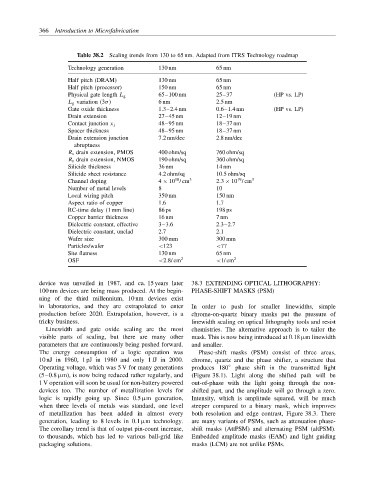
                       Table 38.2 Scaling trends from 130 to 65 nm. Adapted from ITRS Technology roadmap
                     Technology generation     130 nm           65 nm
                     Half pitch (DRAM)         130 nm           65 nm
                     Half pitch (processor)    150 nm           65 nm
                     Physical gate length L g  65–100 nm        25–37            (HP vs. LP)
                     L g variation (3σ)        6 nm             2.5 nm
                     Gate oxide thickness      1.3–2.4 nm       0.6–1.4 nm       (HP vs. LP)
                     Drain extension           27–45 nm         12–19 nm
                                               48–95 nm         18–37 nm
                     Contact junction x j
                     Spacer thickness          48–95 nm         18–37 nm
                     Drain extension junction  7.2 nm/dec       2.8 nm/dec
                       abruptness
                     R s drain extension, PMOS  400 ohm/sq      760 ohm/sq
                     R s drain extension, NMOS  190 ohm/sq      360 ohm/sq
                     Silicide thickness        36 nm            14 nm
                     Silicide sheet resistance  4.2 ohm/sq      10.5 ohm/sq
                                                                      19
                                                    18
                     Channel doping            4 × 10 / cm 3    2.3 × 10 / cm 3
                     Number of metal levels    8                10
                     Local wiring pitch        350 nm           150 nm
                     Aspect ratio of copper    1.6              1.7
                     RC-time delay (1 mm line)  86 ps           198 ps
                     Copper barrier thickness  16 nm            7 nm
                     Dielectric constant, effective  3–3.6      2.3–2.7
                     Dielectric constant, unclad  2.7           2.1
                     Wafer size                300 mm           300 mm
                     Particles/wafer           <123             <77
                     Site flatness              130 nm           65 nm
                     OSF                       <2.8/ cm 2       <1/ cm 2


            device was unveiled in 1987, and ca. 15 years later  38.3 EXTENDING OPTICAL LITHOGRAPHY:
            100 nm devices are being mass produced. At the begin-  PHASE-SHIFT MASKS (PSM)
            ning of the third millennium, 10 nm devices exist
            in laboratories, and they are extrapolated to enter  In order to push for smaller linewidths, simple
            production before 2020. Extrapolation, however, is a  chrome-on-quartz binary masks put the pressure of
            tricky business.                             linewidth scaling on optical lithography tools and resist
              Linewidth and gate oxide scaling are the most  chemistries. The alternative approach is to tailor the
            visible parts of scaling, but there are many other  mask. This is now being introduced at 0.18 µm linewidth
            parameters that are continuously being pushed forward.  and smaller.
            The energy consumption of a logic operation was  Phase-shift masks (PSM) consist of three areas,
            10 nJ in 1960, 1 pJ in 1980 and only 1 fJ in 2000.  chrome, quartz and the phase shifter, a structure that
            Operating voltage, which was 5 V for many generations  produces 180 ◦  phase shift in the transmitted light
            (5–0.8 µm), is now being reduced rather regularly, and  (Figure 38.1). Light along the shifted path will be
            1 V operation will soon be usual for non-battery powered  out-of-phase with the light going through the non-
            devices too. The number of metallization levels for  shifted part, and the amplitude will go through a zero.
            logic is rapidly going up. Since 0.5 µm generation,  Intensity, which is amplitude squared, will be much
            when three levels of metals was standard, one level  steeper compared to a binary mask, which improves
            of metallization has been added in almost every  both resolution and edge contrast, Figure 38.3. There
            generation, leading to 8 levels in 0.1 µm technology.  are many variants of PSMs, such as attenuation phase-
            The corollary trend is that of output pin-count increase,  shift masks (AttPSM) and alternating PSM (altPSM).
            to thousands, which has led to various ball-grid like  Embedded amplitude masks (EAM) and light guiding
            packaging solutions.                         masks (LCM) are not unlike PSMs.

