


Page 388 - Sami Franssila Introduction to Microfabrication
P. 388
Moore’s Law 367


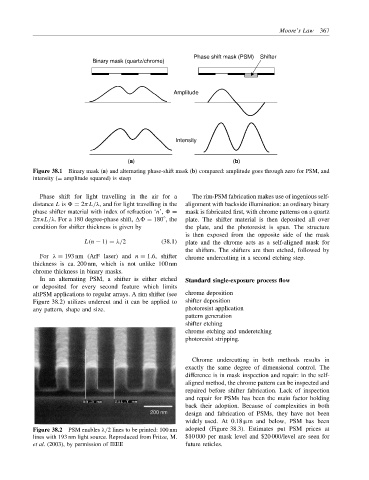
                                                         Phase shift mask (PSM)    Shifter
                            Binary mask (quartz/chrome)


                                                   Amplitude


                                                    Intensity


                                      (a)                            (b)
           Figure 38.1 Binary mask (a) and alternating phase-shift mask (b) compared: amplitude goes through zero for PSM, and
           intensity (= amplitude squared) is steep

             Phase shift for light travelling in the air for a  The rim-PSM fabrication makes use of ingenious self-
           distance L is   = 2πL/λ, and for light travelling in the  alignment with backside illumination: an ordinary binary
           phase shifter material with index of refraction ‘n’,   =  mask is fabricated first, with chrome patterns on a quartz
                                                ◦
           2πnL/λ. For a 180 degree-phase shift,    = 180 , the  plate. The shifter material is then deposited all over
           condition for shifter thickness is given by  the plate, and the photoresist is spun. The structure
                                                       is then exposed from the opposite side of the mask
                         L(n − 1) = λ/2         (38.1)  plate and the chrome acts as a self-aligned mask for
                                                       the shifters. The shifters are then etched, followed by
             For λ = 193 nm (ArF laser) and n = 1.6, shifter  chrome undercutting in a second etching step.
           thickness is ca. 200 nm, which is not unlike 100 nm
           chrome thickness in binary masks.
             In an alternating PSM, a shifter is either etched  Standard single-exposure process flow
           or deposited for every second feature which limits
           altPSM applications to regular arrays. A rim shifter (see  chrome deposition
           Figure 38.2) utilizes undercut and it can be applied to  shifter deposition
           any pattern, shape and size.                photoresist application
                                                       pattern generation
                                                       shifter etching
                                                       chrome etching and underetching
                                                       photoresist stripping.


                                                         Chrome undercutting in both methods results in
                                                       exactly the same degree of dimensional control. The
                                                       difference is in mask inspection and repair: in the self-
                                                       aligned method, the chrome pattern can be inspected and
                                                       repaired before shifter fabrication. Lack of inspection
                                                       and repair for PSMs has been the main factor holding
                                                       back their adoption. Because of complexities in both
                                                       design and fabrication of PSMs, they have not been
                                                       widely used. At 0.18 µm and below, PSM has been
           Figure 38.2 PSM enables λ/2 lines to be printed: 100 nm  adopted (Figure 38.3). Estimates put PSM prices at
           lines with 193 nm light source. Reproduced from Fritze, M.  $10 000 per mask level and $20 000/level are seen for
           et al. (2003), by permission of IEEE        future reticles.

