


Page 389 - Sami Franssila Introduction to Microfabrication
P. 389
368 Introduction to Microfabrication


                                  Double exposure             Single exposure


                                 Quartz                     Quartz


                                 Quartz                      Quartz


                                 Quartz                     Quartz


                                                 Quartz

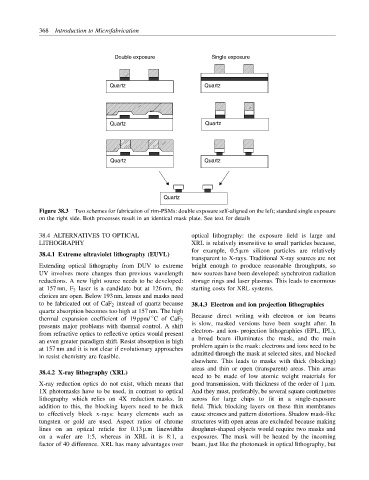
            Figure 38.3 Two schemes for fabrication of rim-PSMs: double exposure self-aligned on the left; standard single exposure
            on the right side. Both processes result in an identical mask plate. See text for details

            38.4 ALTERNATIVES TO OPTICAL                 optical lithography: the exposure field is large and
            LITHOGRAPHY                                  XRL is relatively insensitive to small particles because,
                                                         for example, 0.5 µm silicon particles are relatively
            38.4.1 Extreme ultraviolet lithography (EUVL)
                                                         transparent to X-rays. Traditional X-ray sources are not
            Extending optical lithography from DUV to extreme  bright enough to produce reasonable throughputs, so
            UV involves more changes than previous wavelength  new sources have been developed: synchrotron radiation
            reductions. A new light source needs to be developed:  storage rings and laser plasmas. This leads to enormous
            at 157 nm, F 2 laser is a candidate but at 126 nm, the  starting costs for XRL systems.
            choices are open. Below 193 nm, lenses and masks need
            to be fabricated out of CaF 2 instead of quartz because  38.4.3 Electron and ion projection lithographies
            quartz absorption becomes too high at 157 nm. The high
                                             ◦           Because direct writing with electron or ion beams
            thermal expansion coefficient of 19 ppm/ C of CaF 2
            presents major problems with thermal control. A shift  is slow, masked versions have been sought after. In
            from refractive optics to reflective optics would present  electron- and ion- projection lithographies (EPL, IPL),
            an even greater paradigm shift. Resist absorption is high  a broad beam illuminates the mask, and the main
            at 157 nm and it is not clear if evolutionary approaches  problem again is the mask: electrons and ions need to be
            in resist chemistry are feasible.            admitted through the mask at selected sites, and blocked
                                                         elsewhere. This leads to masks with thick (blocking)
                                                         areas and thin or open (transparent) areas. Thin areas
            38.4.2 X-ray lithography (XRL)
                                                         need to be made of low atomic weight materials for
            X-ray reduction optics do not exist, which means that  good transmission, with thickness of the order of 1 µm.
            1X photomasks have to be used, in contrast to optical  And they must, preferably, be several square centimetres
            lithography which relies on 4X reduction masks. In  across for large chips to fit in a single-exposure
            addition to this, the blocking layers need to be thick  field. Thick blocking layers on these thin membranes
            to effectively block x-rays: heavy elements such as  cause stresses and pattern distortions. Shadow mask-like
            tungsten or gold are used. Aspect ratios of chrome  structures with open areas are excluded because making
            lines on an optical reticle for 0.13 µm linewidths  doughnut-shaped objects would require two masks and
            on a wafer are 1:5, whereas in XRL it is 8:1, a  exposures. The mask will be heated by the incoming
            factor of 40 difference. XRL has many advantages over  beam, just like the photomask in optical lithography, but

