


Page 397 - Sami Franssila Introduction to Microfabrication
P. 397
376 Introduction to Microfabrication


            39.4 BONDING AND LAYER TRANSFER              wafers on top of each other (Figure 39.3). 3D integration
                                                         has been around for decades because it is such an
            Silicon wafers used to be made of silicon, but today,  attractive idea. It is possible to thin CMOS wafers down
            wafers are more complex objects. Layer-transfer tech-  after processing, and align those thinned wafers on top
            niques enable thin layers of expensive or hard-to-make  of other CMOS wafers to realize 3D integration. In
            materials to be transferred on common substrates, such  addition to mechanical joining of the wafers (bonding),
            as SiC on Si, silicon on quartz and germanium on oxi-  the wafers have to be joined electrically too. Metal
            dized silicon, which results in GeOI, germanium on  deposition into vias that extend through the top wafer
            insulator. Bonded wafers with NiSi interlayer have been  has been successfully demonstrated.
            demonstrated for RF circuits and double-bonded starting
            wafers have been described for MOEMS (micro-opto-
            electro-mechanical systems). Layer transfer often neces-
                                                         39.5 DEVICES
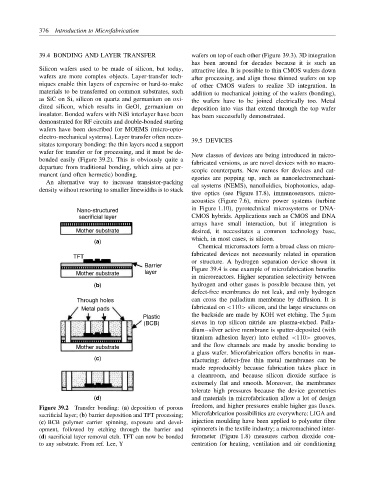
            sitates temporary bonding: the thin layers need a support
            wafer for transfer or for processing, and it must be de-
                                                         New classes of devices are being introduced in micro-
            bonded easily (Figure 39.2). This is obviously quite a
                                                         fabricated versions, as are novel devices with no macro-
            departure from traditional bonding, which aims at per-
                                                         scopic counterparts. New names for devices and cat-
            manent (and often hermetic) bonding.
                                                         egories are popping up, such as nanoelectromechani-
              An alternative way to increase transistor-packing  cal systems (NEMS), nanofluidics, biophotonics, adap-
            density without resorting to smaller linewidths is to stack
                                                         tive optics (see Figure 17.8), immunosensors, micro-
                                                         acoustics (Figure 7.6), micro power systems (turbine
                       Nano-structured                   in Figure 1.10), pyrotechnical microsystems or DNA-
                        sacrificial layer                CMOS hybrids. Applications such as CMOS and DNA
                                                         arrays have small interaction, but if integration is
                       Mother substrate                  desired, it necessitates a common technology base,
                            (a)                          which, in most cases, is silicon.
                                                           Chemical microreactors form a broad class on micro-
                      TFT                                fabricated devices not necessarily related in operation
                                                         or structure. A hydrogen separation device shown in
                                           Barrier
                       Mother substrate    layer         Figure 39.4 is one example of microfabrication benefits
                                                         in microreactors. Higher separation selectivity between
                            (b)                          hydrogen and other gases is possible because thin, yet
                                                         defect-free membranes do not leak, and only hydrogen
                       Through holes                     can cross the palladium membrane by diffusion. It is
                         Metal pads                      fabricated on <110> silicon, and the large structures on
                                           Plastic       the backside are made by KOH wet etching. The 5 µm
                                           (BCB)         sieves in top silicon nitride are plasma-etched. Palla-
                                                         dium–silver active membrane is sputter-deposited (with
                                                         titanium adhesion layer) into etched <110> grooves,
                       Mother substrate                  and the flow channels are made by anodic bonding to
                                                         a glass wafer. Microfabrication offers benefits in man-
                            (c)                          ufacturing: defect-free thin metal membranes can be
                                                         made reproducibly because fabrication takes place in
                                                         a cleanroom, and because silicon dioxide surface is
                                                         extremely flat and smooth. Moreover, the membranes
                                                         tolerate high pressures because the device geometries
                            (d)                          and materials in microfabrication allow a lot of design
            Figure 39.2 Transfer bonding: (a) deposition of porous  freedom, and higher pressures enable higher gas fluxes.
            sacrificial layer; (b) barrier deposition and TFT processing;  Microfabrication possibilities are everywhere: LIGA and
            (c) BCB polymer carrier spinning, exposure and devel-  injection moulding have been applied to polyester fibre
            opment, followed by etching through the barrier and  spinnerets in the textile industry; a micromachined inter-
            (d) sacrificial layer removal etch. TFT can now be bonded  ferometer (Figure 1.8) measures carbon dioxide con-
            to any substrate. From ref. Lee, Y           centration for heating, ventilation and air conditioning

