


Page 396 - Sami Franssila Introduction to Microfabrication
P. 396
Microfabrication at Large  375


           39.3 TOOLS OF MICROFABRICATION                       SF  plasma     Born implant
                                                                  6
                                                                                           Thin
           Because of ever increasing metrology needs, microsys-                           oxide
           tems have many possible applications in the micro-  Resist
           fabrication industries. Residual gas analysis (RGA) in       Oxide
           vacuum chambers is one application in which microsys-  (a)  Silicon              (d)
           tems have already been commercialized. Instead of
           bulky traditional mass spectrometers, vacuum residual  Oxide                    Al
           gases are analysed by microfabricated mass spectrom-
           eters. Their performance does not match that of tra-  (b)                        (e)
           ditional instruments, perfected over decades, but the
           lower price makes it possible to install residual gas  Buried  Silicon
           analysers in every vacuum equipment, for routine mon-  oxide
           itoring. In the past, RGA was a special tool that
           was used in troubleshooting and system check-ups  (c)  Silicon                   (f)
           by professionals. Another microfabricated tool that is                TMAH
           useful for microstructure characterization is the near  Nitride  SOI wafer  etch
           field scanning optical microscope (NSOM). The res-
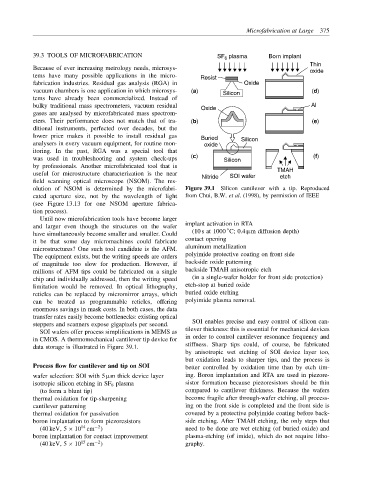
           olution of NSOM is determined by the microfabri-  Figure 39.1 Silicon cantilever with a tip. Reproduced
           cated aperture size, not by the wavelength of light  from Chui, B.W. et al. (1998), by permission of IEEE
           (see Figure 13.13 for one NSOM aperture fabrica-
           tion process).
             Until now microfabrication tools have become larger
           and larger even though the structures on the wafer  implant activation in RTA
                                                                   ◦
           have simultaneously become smaller and smaller. Could  (10 s at 1000 C; 0.4 µm diffusion depth)
           it be that some day micromachines could fabricate  contact opening
           microstructures? One such tool candidate is the AFM.  aluminum metallization
           The equipment exists, but the writing speeds are orders  polyimide protective coating on front side
           of magnitude too slow for production. However, if  backside oxide patterning
           millions of AFM tips could be fabricated on a single  backside TMAH anisotropic etch
           chip and individually addressed, then the writing speed  (in a single-wafer holder for front side protection)
           limitation would be removed. In optical lithography,  etch-stop at buried oxide
           reticles can be replaced by micromirror arrays, which  buried oxide etching
           can be treated as programmable reticles, offering  polyimide plasma removal.
           enormous savings in mask costs. In both cases, the data
           transfer rates easily become bottlenecks: existing optical
                                                         SOI enables precise and easy control of silicon can-
           steppers and scanners expose gigapixels per second.
                                                       tilever thickness: this is essential for mechanical devices
             SOI wafers offer process simplifications in MEMS as
           in CMOS. A thermomechanical cantilever tip device for  in order to control cantilever resonance frequency and
           data storage is illustrated in Figure 39.1.  stiffness. Sharp tips could, of course, be fabricated
                                                       by anisotropic wet etching of SOI device layer too,
                                                       but oxidation leads to sharper tips, and the process is
           Process flow for cantilever and tip on SOI   better controlled by oxidation time than by etch tim-
           wafer selection: SOI with 5 µm thick device layer  ing. Boron implantation and RTA are used in piezore-
           isotropic silicon etching in SF 6 plasma    sistor formation because piezoresistors should be thin
             (to form a blunt tip)                     compared to cantilever thickness. Because the wafers
           thermal oxidation for tip-sharpening        become fragile after through-wafer etching, all process-
           cantilever patterning                       ing on the front side is completed and the front side is
           thermal oxidation for passivation           covered by a protective polyimide coating before back-
           boron implantation to form piezoresistors   side etching. After TMAH etching, the only steps that
                         14
                            −2
             (40 keV, 5 × 10 cm )                      need to be done are wet etching (of buried oxide) and
           boron implantation for contact improvement  plasma-etching (of imide), which do not require litho-
                            −2
                         15
             (40 keV, 5 × 10 cm )                      graphy.

