


Page 128 - Low Temperature Energy Systems with Applications of Renewable Energy
P. 128
Effective use of heat pumps for various heating applications      117


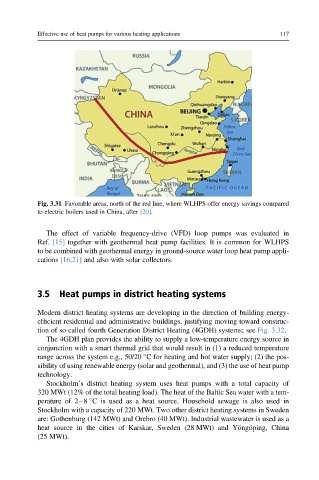
           Fig. 3.31 Favorable areas, north of the red line, where WLHPS offer energy savings compared
           to electric boilers used in China, after [20].


              The effect of variable frequency-drive (VFD) loop pumps was evaluated in
           Ref. [15] together with geothermal heat pump facilities. It is common for WLHPS
           to be combined with geothermal energy in ground-source water loop heat pump appli-
           cations [16,21] and also with solar collectors.


           3.5   Heat pumps in district heating systems

           Modern district heating systems are developing in the direction of building energy-
           efficient residential and administrative buildings, justifying moving toward construc-
           tion of so-called fourth Generation District Heating (4GDH) systems; see Fig. 3.32.
              The 4GDH plan provides the ability to supply a low-temperature energy source in
           conjunction with a smart thermal grid that would result in (1) a reduced temperature
           range across the system e.g., 50/20 C for heating and hot water supply; (2) the pos-

           sibility of using renewable energy (solar and geothermal), and (3) the use of heat pump
           technology.
              Stockholm’s district heating system uses heat pumps with a total capacity of
           320 MWt (12% of the total heating load). The heat of the Baltic Sea water with a tem-

           perature of 2e8 C is used as a heat source. Household sewage is also used in
           Stockholm with a capacity of 220 MWt. Two other district heating systems in Sweden
           are: Gothenburg (142 MWt) and Orebro (40 MWt). Industrial wastewater is used as a
           heat source in the cities of Karskar, Sweden (28 MWt) and Y€ ong€ oping, China
           (25 MWt).

