


Page 129 - Low Temperature Energy Systems with Applications of Renewable Energy
P. 129
118                 Low-Temperature Energy Systems with Applications of Renewable Energy


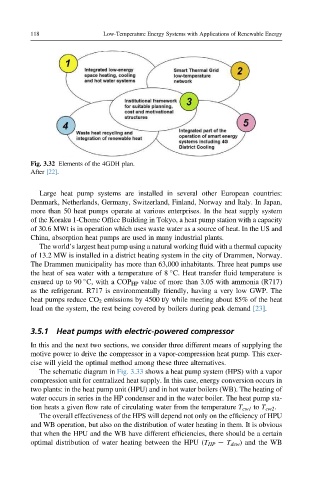
         Fig. 3.32 Elements of the 4GDH plan.
         After [22].

            Large heat pump systems are installed in several other European countries:
         Denmark, Netherlands, Germany, Switzerland, Finland, Norway and Italy. In Japan,
         more than 50 heat pumps operate at various enterprises. In the heat supply system
         of the Koraku 1-Chome Office Building in Tokyo, a heat pump station with a capacity
         of 30.6 MWt is in operation which uses waste water as a source of heat. In the US and
         China, absorption heat pumps are used in many industrial plants.
            The world’s largest heat pump using a natural working fluid with a thermal capacity
         of 13.2 MW is installed in a district heating system in the city of Drammen, Norway.
         The Drammen municipality has more than 63,000 inhabitants. Three heat pumps use

         the heat of sea water with a temperature of 8 C. Heat transfer fluid temperature is

         ensured up to 90 C, with a COP HP value of more than 3.05 with ammonia (R717)
         as the refrigerant. R717 is environmentally friendly, having a very low GWP. The
         heat pumps reduce CO 2 emissions by 4500 t/y while meeting about 85% of the heat
         load on the system, the rest being covered by boilers during peak demand [23].

         3.5.1  Heat pumps with electric-powered compressor

         In this and the next two sections, we consider three different means of supplying the
         motive power to drive the compressor in a vapor-compression heat pump. This exer-
         cise will yield the optimal method among these three alternatives.
            The schematic diagram in Fig. 3.33 shows a heat pump system (HPS) with a vapor
         compression unit for centralized heat supply. In this case, energy conversion occurs in
         two plants: in the heat pump unit (HPU) and in hot water boilers (WB). The heating of
         water occurs in series in the HP condenser and in the water boiler. The heat pump sta-
         tion heats a given flow rate of circulating water from the temperature T cw1 to T cw2 .
            The overall effectiveness of the HPS will depend not only on the efficiency of HPU
         and WB operation, but also on the distribution of water heating in them. It is obvious
         that when the HPU and the WB have different efficiencies, there should be a certain
         optimal distribution of water heating between the HPU (T HP e T dcw ) and the WB

