


Page 131 - Low Temperature Energy Systems with Applications of Renewable Energy
P. 131
120                 Low-Temperature Energy Systems with Applications of Renewable Energy


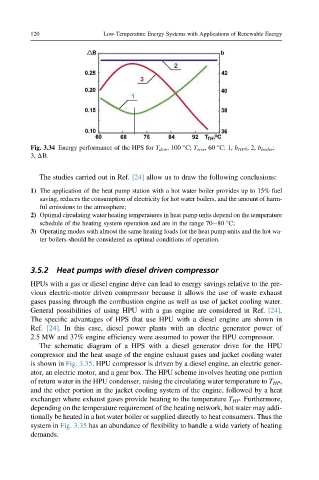
         Fig. 3.34 Energy performance of the HPS for T dcw , 100 C; T rcw ,60 C: 1, b HPS ;2, b boiler ;
         3, DC.

            The studies carried out in Ref. [24] allow us to draw the following conclusions:
         1) The application of the heat pump station with a hot water boiler provides up to 15% fuel
            saving, reduces the consumption of electricity for hot water boilers, and the amount of harm-
            ful emissions to the atmosphere;
         2) Optimal circulating water heating temperatures in heat pump units depend on the temperature
            schedule of the heating system operation and are in the range 70e80 C;

         3) Operating modes with almost the same heating loads for the heat pump units and the hot wa-
            ter boilers should be considered as optimal conditions of operation.


         3.5.2  Heat pumps with diesel driven compressor

         HPUs with a gas or diesel engine drive can lead to energy savings relative to the pre-
         vious electric-motor driven compressor because it allows the use of waste exhaust
         gases passing through the combustion engine as well as use of jacket cooling water.
         General possibilities of using HPU with a gas engine are considered in Ref. [24].
         The specific advantages of HPS that use HPU with a diesel engine are shown in
         Ref. [24]. In this case, diesel power plants with an electric generator power of
         2.5 MW and 37% engine efficiency were assumed to power the HPU compressor.
            The schematic diagram of a HPS with a diesel generator drive for the HPU
         compressor and the heat usage of the engine exhaust gases and jacket cooling water
         is shown in Fig. 3.35. HPU compressor is driven by a diesel engine, an electric gener-
         ator, an electric motor, and a gear box. The HPU scheme involves heating one portion
         of return water in the HPU condenser, raising the circulating water temperature to T HP ,
         and the other portion in the jacket cooling system of the engine, followed by a heat
         exchanger where exhaust gases provide heating to the temperature T HP . Furthermore,
         depending on the temperature requirement of the heating network, hot water may addi-
         tionally be heated in a hot water boiler or supplied directly to heat consumers. Thus the
         system in Fig. 3.35 has an abundance of flexibility to handle a wide variety of heating
         demands.

