


Page 367 - MATLAB an introduction with applications
P. 367
352 ——— MATLAB: An Introduction with Applications
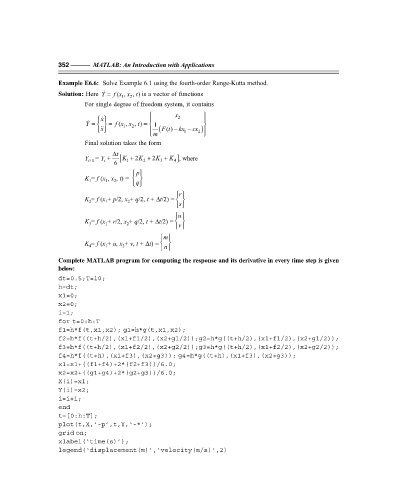
Example E6.6: Solve Example 6.1 using the fourth-order Runge-Kutta method.
Solution: Here Y = f (, , ) is a vector of functions
x
t
x
2
1
For single degree of freedom system, it contains
x 2
x
x
Y = = f (, , ) = 1
t
x
)
2
1
x
F
m ( () t − kx − cx 2
1
Final solution takes the form
t ∆
Y = Y + [K + 2K + 2K + K ], where
i
i+1
6 1 2 3 4
p
K = f (x , x , t) =
1
2
1
q
r
K = f (x + p/2, x + q/2, t + ∆t/2) =
1
2
2
s
u
K = f (x + r/2, x + q/2, t + ∆t/2) =
2
3
1
v
m
K = f (x + u, x + v, t + ∆t) =
4
n
2
1
Complete MATLAB program for computing the response and its derivative in every time step is given
below:
dt=0.5;T=10;
h=dt;
x1=0;
x2=0;
i=1;
for t=0:h:T
f1=h*f(t,x1,x2); g1=h*g(t,x1,x2);
f2=h*f((t+h/2),(x1+f1/2),(x2+g1/2));g2=h*g((t+h/2),(x1+f1/2),(x2+g1/2));
f3=h*f((t+h/2),(x1+f2/2),(x2+g2/2));g3=h*g((t+h/2),(x1+f2/2),(x2+g2/2));
f4=h*f((t+h),(x1+f3),(x2+g3)); g4=h*g((t+h),(x1+f3),(x2+g3));
x1=x1+((f1+f4)+2*(f2+f3))/6.0;
x2=x2+((g1+g4)+2*(g2+g3))/6.0;
X(i)=x1;
Y(i)=x2;
i=i+1;
end
t=[0:h:T];
plot(t,X,‘-p’,t,Y,‘-*’);
grid on;
xlabel(‘time(s)’);
legend(‘displacement(m)’,‘velocity(m/s)’,2)

