


Page 369 - MATLAB an introduction with applications
P. 369
354 ———  MATLAB: An Introduction with Applications

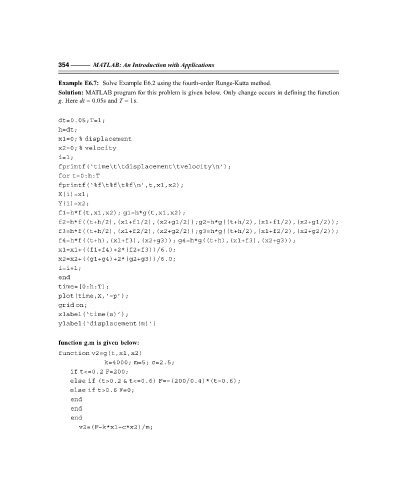
                   Example E6.7:  Solve Example E6.2 using the fourth-order Runge-Kutta method.
                   Solution: MATLAB program for this problem is given below. Only change occurs in defining the function
                   g. Here dt = 0.05s and T = 1s.


                   dt=0.05;T=1;
                   h=dt;
                   x1=0; % displacement
                   x2=0; % velocity
                   i=1;
                   fprintf(‘time\t\tdisplacement\tvelocity\n’);
                   for t=0:h:T
                   fprintf(‘%f\t%f\t%f\n’,t,x1,x2);
                   X(i)=x1;
                   Y(i)=x2;
                   f1=h*f(t,x1,x2); g1=h*g(t,x1,x2);
                   f2=h*f((t+h/2),(x1+f1/2),(x2+g1/2));g2=h*g((t+h/2),(x1+f1/2),(x2+g1/2));
                   f3=h*f((t+h/2),(x1+f2/2),(x2+g2/2));g3=h*g((t+h/2),(x1+f2/2),(x2+g2/2));
                   f4=h*f((t+h),(x1+f3),(x2+g3)); g4=h*g((t+h),(x1+f3),(x2+g3));
                   x1=x1+((f1+f4)+2*(f2+f3))/6.0;
                   x2=x2+((g1+g4)+2*(g2+g3))/6.0;
                   i=i+1;
                   end
                   time=[0:h:T];
                   plot(time,X,‘–p’);
                   grid on;
                   xlabel(‘time(s)’);
                   ylabel(‘displacement(m)’)

                   function g.m is given below:

                   function v2=g(t,x1,x2)
                                 k=4000; m=5; c=2.5;
                         if t<=0.2 F=200;
                         else if (t>0.2 & t<=0.6) F=–(200/0.4)*(t–0.6);
                         else if t>0.6 F=0;
                         end
                         end
                         end
                         v2=(F–k*x1–c*x2)/m;

