


Page 402 - Mechanical Engineers' Handbook (Volume 4)
P. 402
2 Heat-Transfer Correlations for Electronic Equipment Cooling  391

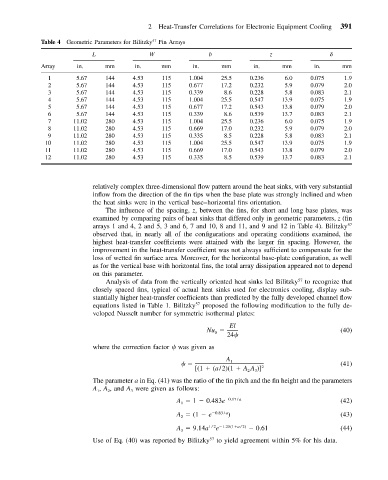
            Table 4 Geometric Parameters for Bilitzky Fin Arrays
                                           57
                           L              W                b                z
            Array     in.     mm       in.    mm       in.     mm      in.     mm       in.     mm
              1       5.67    144     4.53    115     1.004   25.5    0.236     6.0    0.075     1.9
              2       5.67    144     4.53    115     0.677   17.2    0.232     5.9    0.079     2.0
              3       5.67    144     4.53    115     0.339    8.6    0.228     5.8    0.083     2.1
              4       5.67    144     4.53    115     1.004   25.5    0.547    13.9    0.075     1.9
              5       5.67    144     4.53    115     0.677   17.2    0.543    13.8    0.079     2.0
              6       5.67    144     4.53    115     0.339    8.6    0.539    13.7    0.083     2.1
              7      11.02    280     4.53    115     1.004   25.5    0.236     6.0    0.075     1.9
              8      11.02    280     4.53    115     0.669   17.0    0.232     5.9    0.079     2.0
              9      11.02    280     4.53    115     0.335    8.5    0.228     5.8    0.083     2.1
              10     11.02    280     4.53    115     1.004   25.5    0.547    13.9    0.075     1.9
              11     11.02    280     4.53    115     0.669   17.0    0.543    13.8    0.079     2.0
              12     11.02    280     4.53    115     0.335    8.5    0.539    13.7    0.083     2.1


                           relatively complex three-dimensional flow pattern around the heat sinks, with very substantial
                           inflow from the direction of the fin tips when the base plate was strongly inclined and when
                           the heat sinks were in the vertical base–horizontal fins orientation.
                              The influence of the spacing, z, between the fins, for short and long base plates, was
                           examined by comparing pairs of heat sinks that differed only in geometric parameters, z (fin
                           arrays 1 and 4, 2 and 5, 3 and 6, 7 and 10, 8 and 11, and 9 and 12 in Table 4). Bilitzky 57
                           observed that, in nearly all of the configurations and operating conditions examined, the
                           highest heat-transfer coefficients were attained with the larger fin spacing. However, the
                           improvement in the heat-transfer coefficient was not always sufficient to compensate for the
                           loss of wetted fin surface area. Moreover, for the horizontal base-plate configuration, as well
                           as for the vertical base with horizontal fins, the total array dissipation appeared not to depend
                           on this parameter.
                              Analysis of data from the vertically oriented heat sinks led Bilitzky to recognize that
                                                                                    57
                           closely spaced fins, typical of actual heat sinks used for electronics cooling, display sub-
                           stantially higher heat-transfer coefficients than predicted by the fully developed channel flow
                           equations listed in Table 1. Bilitzky 57  proposed the following modification to the fully de-
                           veloped Nusselt number for symmetric isothermal plates:
                                                                 El
                                                          Nu                                    (40)
                                                             0
                                                                24
                           where the correction factor   was given as
                                                                A
                                                                 1                              (41)
                                                       [(1   (a/2)(1   AA )] 2
                                                                      2
                                                                        3
                           The parameter a in Eq. (41) was the ratio of the fin pitch and the fin height and the parameters
                           A , A , and A were given as follows:
                            1
                                     3
                               2
                                                  A   1   0.483e  0.17 / a                      (42)
                                                   1
                                                  A   (1   e  0.83 / a )                        (43)
                                                   2
                                                             e
                                                  A   9.14a 1/2  1.25(1 a /2)    0.61           (44)
                                                   3
                           Use of Eq. (40) was reported by Bilitzky to yield agreement within 5% for his data.
                                                           57

