


Page 404 - Mechanical Engineers' Handbook (Volume 4)
P. 404
2 Heat-Transfer Correlations for Electronic Equipment Cooling  393

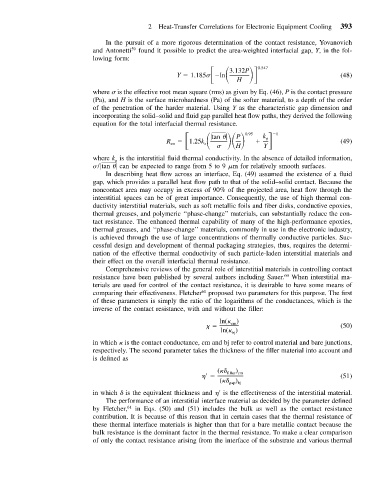
                              In the pursuit of a more rigorous determination of the contact resistance, Yovanovich
                           and Antonetti 59  found it possible to predict the area-weighted interfacial gap, Y, in the fol-
                           lowing form:
                                                  Y   1.185   ln    3.132P    0.547
                                                                   H                            (48)

                           where   is the effective root mean square (rms) as given by Eq. (46), P is the contact pressure
                           (Pa), and H is the surface microhardness (Pa) of the softer material, to a depth of the order
                           of the penetration of the harder material. Using Y as the characteristic gap dimension and
                           incorporating the solid–solid and fluid gap parallel heat flow paths, they derived the following
                           equation for the total interfacial thermal resistance.
                                               R                     0.95      1

tan
                                                                          k
                                                                   P
                                                                           g
                                                    1.25k
                                                co
                                                          s
                                                                   H      Y                     (49)
                                  is the interstitial fluid thermal conductivity. In the absence of detailed information,
                           where k g
                            /
tan
  can be expected to range from 5 to 9  m for relatively smooth surfaces.
                              In describing heat flow across an interface, Eq. (49) assumed the existence of a fluid
                           gap, which provides a parallel heat flow path to that of the solid–solid contact. Because the
                           noncontact area may occupy in excess of 90% of the projected area, heat flow through the
                           interstitial spaces can be of great importance. Consequently, the use of high thermal con-
                           ductivity interstitial materials, such as soft metallic foils and fiber disks, conductive epoxies,
                           thermal greases, and polymeric ‘‘phase-change’’ materials, can substantially reduce the con-
                           tact resistance. The enhanced thermal capability of many of the high-performance epoxies,
                           thermal greases, and ‘‘phase-change’’ materials, commonly in use in the electronic industry,
                           is achieved through the use of large concentrations of thermally conductive particles. Suc-
                           cessful design and development of thermal packaging strategies, thus, requires the determi-
                           nation of the effective thermal conductivity of such particle-laden interstitial materials and
                           their effect on the overall interfacial thermal resistance.
                              Comprehensive reviews of the general role of interstitial materials in controlling contact
                           resistance have been published by several authors including Sauer. 60  When interstitial ma-
                           terials are used for control of the contact resistance, it is desirable to have some means of
                                                         61
                           comparing their effectiveness. Fletcher proposed two parameters for this purpose. The first
                           of these parameters is simply the ratio of the logarithms of the conductances, which is the
                           inverse of the contact resistance, with and without the filler:
                                                              ln(  )
                                                                 cm                             (50)
                                                              ln(  )
                                                                 bj
                           in which   is the contact conductance, cm and bj refer to control material and bare junctions,
                           respectively. The second parameter takes the thickness of the filler material into account and
                           is defined as
                                                             (   filler cm
                                                                  )

                                     (51)
                                                              (   )
                                                                 gap bj
                           in which   is the equivalent thickness and
 is the effectiveness of the interstitial material.
                              The performance of an interstitial interface material as decided by the parameter defined
                           by Fletcher, 61  in Eqs. (50) and (51) includes the bulk as well as the contact resistance
                           contribution. It is because of this reason that in certain cases that the thermal resistance of
                           these thermal interface materials is higher than that for a bare metallic contact because the
                           bulk resistance is the dominant factor in the thermal resistance. To make a clear comparison
                           of only the contact resistance arising from the interface of the substrate and various thermal

