


Page 403 - Mechanical Engineers' Handbook (Volume 4)
P. 403
392   Cooling Electronic Equipment

           2.3 Thermal Interface Resistance
                          Heat transfer across a solid interface is accompanied by a temperature difference, caused by
                          imperfect contact between the two solids. Even when perfect adhesion is achieved between
                          the solids, the transfer of heat is impeded by the acoustic mismatch in the properties of the
                          phonons on either side of the interface. Traditionally the thermal resistance arising due to
                          imperfect contact has been called the ‘‘thermal contact’’ resistance. The resistance due to the
                          mismatch in the acoustic properties is usually termed the ‘‘thermal boundary’’ resistance.
                          The thermal contact resistance is a macroscopic phenomenon, whereas thermal boundary
                          resistance is a microscopic phenomenon. This section primarily focuses on thermal contact
                          resistance and methods to reduce the contact resistance.
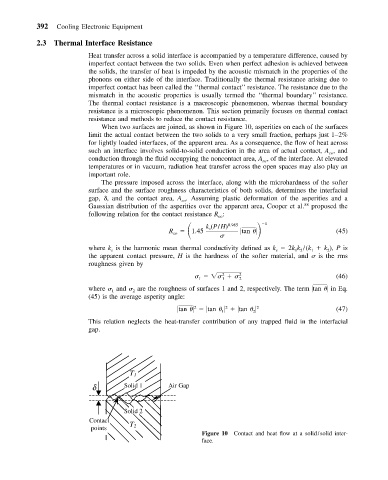
                             When two surfaces are joined, as shown in Figure 10, asperities on each of the surfaces
                          limit the actual contact between the two solids to a very small fraction, perhaps just 1–2%
                          for lightly loaded interfaces, of the apparent area. As a consequence, the flow of heat across
                          such an interface involves solid-to-solid conduction in the area of actual contact, A , and
                                                                                            co
                          conduction through the fluid occupying the noncontact area, A , of the interface. At elevated
                                                                          nc
                          temperatures or in vacuum, radiation heat transfer across the open spaces may also play an
                          important role.
                             The pressure imposed across the interface, along with the microhardness of the softer
                          surface and the surface roughness characteristics of both solids, determines the interfacial
                          gap,  , and the contact area, A . Assuming plastic deformation of the asperities and a
                                                   co
                          Gaussian distribution of the asperities over the apparent area, Cooper et al. 58  proposed the
                          following relation for the contact resistance R :
                                                              co
                                                R         k (P/H) 0.985
tan
   1
                                                           s
                                                     1.45
                                                 co
                                                                                              (45)
                          where k is the harmonic mean thermal conductivity defined as k   2k k /(k   k ), P is
                                                                                            2
                                                                                       1
                                                                                   1 2
                                                                              s
                                s
                          the apparent contact pressure, H is the hardness of the softer material, and   is the rms
                          roughness given by
                                                                   2 2                        (46)
                                                               2
                                                               1
                                                        1
                          where   and   are the roughness of surfaces 1 and 2, respectively. The term
tan
  in Eq.
                                1     2
                          (45) is the average asperity angle:

tan

tan

tan
 2             (47)
                                                       2
                                                                2
                                                               1
                                                                       2
                          This relation neglects the heat-transfer contribution of any trapped fluid in the interfacial
                          gap.

                                     T 1
                           δ        Solid 1     Air Gap

                                    Solid 2
                          Contact
                                     T 2
                           points
                                                         Figure 10 Contact and heat flow at a solid/solid inter-
                                                         face.

