


Page 138 - MODELING OF ASPHALT CONCRETE
P. 138
116    Cha pte r  F o u r

                                     ∗
                                                                               6
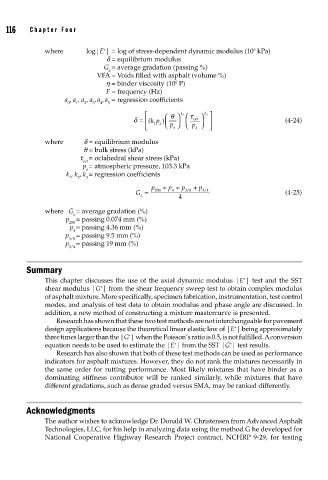
                    where       log|E | = log of stress-dependent dynamic modulus (10  kPa)
                                      d = equilibrium modulus
                                     G = average gradation (passing %)
                                      a
                                   VFA = Voids filled with asphalt (volume %)
                                     h = binder viscosity (10  P)
                                                         6
                                     F = frequency (Hz)
                          a , a , a , a ,a ,a  = regression coefficients
                           0  1  2  3  4  5
                                                ⎡     ⎛  θ ⎞ ⎛  τ  ⎞  k 3  ⎤
                                                           k 2
                                             δ = ⎢(kp  ) ⎜  ⎟ ⎜  oct  ⎟ ⎥               (4-24)
                                                ⎣  1  a  ⎝ p a  ⎠ ⎝ p a  ⎠  ⎦
                    where      d = equilibrium modulus
                               q = bulk stress (kPa)
                              t = octahedral shear stress (kPa)
                               oct
                               p = atmospheric pressure, 103.3 kPa
                                a
                          k , k , k = regression coefficients
                           1  2  3
                                                  p  +  p +  p  +  p
                                              G =  200  4   3 8  3 4                    (4-25)
                                                                 /
                                                            /
                                               a          4
                    where  G = average gradation (%)
                            a
                          p  = passing 0.074 mm (%)
                           200
                           p = passing 4.36 mm (%)
                            4
                          p  = passing 9.5 mm (%)
                           3/8
                          p  = passing 19 mm (%)
                           3/4
               Summary
                                                                            ∗
                    This chapter discusses the use of the axial dynamic modulus |E | test and the SST
                                    ∗
                    shear modulus |G | from the shear frequency sweep test to obtain complex modulus
                    of asphalt mixture. More specifically, specimen fabrication, instrumentation, test control
                    modes, and analysis of test data to obtain modulus and phase angle are discussed. In
                    addition, a new method of constructing a mixture mastercurve is presented.
                       Research has shown that these two test methods are not interchangeable for pavement
                                                                          ∗
                    design applications because the theoretical linear elastic law of |E | being approximately
                                            ∗
                    three times larger than the |G | when the Poisson’s ratio is 0.5, is not fulfilled. A conversion
                                                         ∗
                                                                        ∗
                    equation needs to be used to estimate the |E | from the SST |G | test results.
                       Research has also shown that both of these test methods can be used as performance
                    indicators for asphalt mixtures. However, they do not rank the mixtures necessarily in
                    the same order for rutting performance. Most likely mixtures that have binder as a
                    dominating stiffness contributor will be ranked similarly, while mixtures that have
                    different gradations, such as dense graded versus SMA, may be ranked differently.


               Acknowledgments
                    The author wishes to acknowledge Dr. Donald W. Christensen from Advanced Asphalt
                    Technologies, LLC, for his help in analyzing data using the method G he developed for
                    National Cooperative Highway Research Project contract, NCHRP 9-29, for testing

