


Page 136 - MODELING OF ASPHALT CONCRETE
P. 136
114    Cha pte r  F o u r


                    asymptotic mix stiffness values at cold temperatures.  At warm temperatures
                    mastercurves deviated indicating that the mixture stiffness was affected by the applied
                    stress state, that is, stress to strength ratio and bulk stress q. At cold and intermediate
                    temperatures the measured strain levels stayed under 100 microsstrains for all applied
                    stress levels, but at high temperatures the high stress levels produced resilient strains up
                    to 1000 microstrains.
                    Model Development
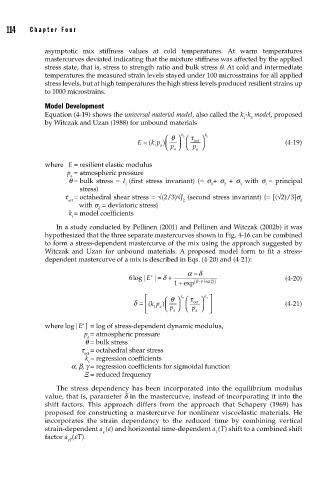
                    Equation (4-19) shows the universal material model, also called the k -k model, proposed
                                                                            1  3
                    by Witczak and Uzan (1988) for unbound materials
                                                      ⎛ θ ⎞ ⎛ τ  ⎞  k 3
                                                           k 2
                                                              oct
                                                          ⎟ ⎜
                                                     a ⎜
                                              E = ( k p ) ⎝  p ⎠ ⎝  p ⎠ ⎟               (4-19)
                                                   1
                                                         a
                                                               a
                    where  E = resilient elastic modulus
                          p  = atmospheric pressure
                           a
                           q =  bulk stress =  I (first stress invariant) (=  s + s  +  s  with  s = principal
                                           1                       1   2   3      i
                              stress)
                          t =  octahedral shear stress = √(2/3)√J  (second stress invariant) {= [(√2)/3]s
                           oct                             2                                d
                              with s  = deviatoric stress}
                                   d
                           k = model coefficients
                            i
                       In a study conducted by Pellinen (2001) and Pellinen and Witczak (2002b) it was
                    hypothesized that the three separate mastercurves shown in Fig. 4-16 can be combined
                    to form a stress-dependent mastercurve of the mix using the approach suggested by
                    Witczak and Uzan for unbound materials.  A proposed model form to fit a stress-
                    dependent mastercurve of a mix is described in Eqs. (4-20) and (4-21):
                                                            α − δ
                                            6log|E ∗ |= δ +   (βγ log( ))               (4-20)
                                                                   ξ
                                                          +
                                                                −
                                                         1 exp
                                                ⎡     ⎛  θ ⎞ ⎛  τ  ⎞  k 3  ⎤
                                                           k 2
                                             δ = ⎢(kp a  ) ⎜  ⎟ ⎜  oct  ⎟ ⎥             (4-21)
                                                   1
                                                ⎣     ⎝ p a  ⎠ ⎝ p a  ⎠  ⎦
                               ∗
                    where log|E | = log of stress-dependent dynamic modulus,
                               p = atmospheric pressure
                                a
                                q = bulk stress
                              t = octahedral shear stress
                               oct
                                k = regression coefficients
                                i
                            a, b, g = regression coefficients for sigmoidal function
                               X = reduced frequency
                       The stress dependency has been incorporated into the equilibrium modulus
                    value, that is, parameter d in the mastercurve, instead of incorporating it into the
                    shift factors. This approach differs from the approach that Schapery (1969) has
                    proposed for constructing a mastercurve for nonlinear viscoelastic materials. He
                    incorporates the strain dependency to the reduced time by combining vertical
                    strain-dependent a (e) and horizontal time-dependent a (T) shift to a combined shift
                                     e                              T
                    factor a (eT).
                           eT

