


Page 132 - MODELING OF ASPHALT CONCRETE
P. 132
110    Cha pte r  F o u r


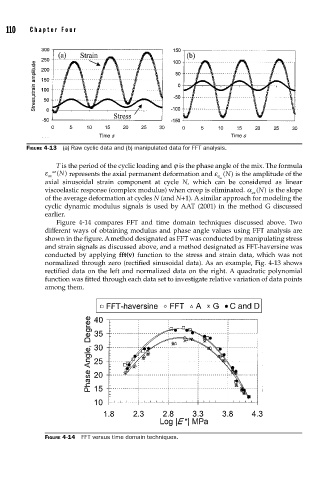
               FIGURE 4-13  (a) Raw cyclic data and (b) manipulated data for FFT analysis.

                       T is the period of the cyclic loading and j is the phase angle of the mix. The formula
                    ε  av ()                                           N) is the amplitude of the
                        N  represents the axial permanent deformation and ε (
                     ax
                                                                     0 ax
                    axial sinusoidal strain component at cycle  N, which can be considered as linear
                    viscoelastic response (complex modulus) when creep is eliminated. α ( N) is the slope
                                                                               ax
                    of the average deformation at cycles N (and N+1). A similar approach for modeling the
                    cyclic dynamic modulus signals is used by AAT (2001) in the method G discussed
                    earlier.
                       Figure 4-14 compares FFT and time domain techniques discussed above. Two
                    different ways of obtaining modulus and phase angle values using FFT analysis are
                    shown in the figure. A method designated as FFT was conducted by manipulating stress
                    and strain signals as discussed above, and a method designated as FFT-haversine was
                    conducted by applying  fft(v) function to the stress and strain data, which was not
                    normalized through zero (rectified sinusoidal data). As an example, Fig. 4-13 shows
                    rectified data on the left and normalized data on the right. A quadratic polynomial
                    function was fitted through each data set to investigate relative variation of data points
                    among them.


                    FIGURE 4-14  FFT versus time domain techniques.

