


Page 130 - MODELING OF ASPHALT CONCRETE
P. 130
108    Cha pte r  F o u r


                             −9°C         4.4°C        21.1°C      37.8°C       54.4°C
                                    Se           Se          Se           Se           Se
                Hz    Case   j  (°)  (%)  j  (°)  (%)  j (°)  (%)  j (°)  (%)   j (°)  (%)
                25    A      10.2    1.7  17.4    2.4  31.0   1.4  34.1    4.2  32.7    1.1
                      B       7.2   25.0  19.8    9.1  41.4   5.3  41.4    8.7  43.2    7.8
                      C       9.0    5.0  18.2    1.6  32.0   1.6  34.5    1.2  33.2    0.6
                      D       9.9    6.8  20.0    4.5  42.8   7.8  39.0    4.3  40.7    3.7
                      E       9.9    3.2  17.3    1.8  31.8   2.4  34.4    7.0  32.9    1.8
                      F       7.2   61.2  14.4   15.3  43.2  12.1  48.6   12.6  50.4    4.4
                      G      10.8     –   19.5      –  33.1     –  36.8      –  34.7      –
                5     A      12.1    1.7  21.1    0.4  33.3   1.1  31.9    1.3  28.7    2.9
                      B      12.2   37.9  22.3   18.0  38.2  14.2  40.3   18.4  31.0    7.9
                      C      12.0    1.8  22.7    1.5  34.0   0.9  31.3    1.5  29.3    1.5
                      D      12.6    6.2  23.9    2.8  34.0   2.7  34.7    8.2  29.3    4.0
                      E      11.9    3.4  20.9    0.7  34.0   1.2  32.4    1.3  28.7    3.7
                      F       7.9   73.9  25.2   20.7  41.0  17.7  40.3   24.0  38.2   13.5
                      G      12.1      –  21.8      –  32.3     –  30.7      –  27.3      –
                0.1   A      16.1    1.0  29.9    0.5  31.5   1.3  23.6    1.7  21.7    1.2
                      B      17.3    7.8  32.4    3.5  33.1   7.2  27.4    6.7  21.6   13.9
                      C      17.2    1.1  33.3    0.2  36.5   0.7  27.4    1.2  25.1    1.4
                      D      17.8    3.2  33.4    0.5  36.2   2.1  26.9    1.6  22.3    3.6
                      E      15.6    1.1  30.0    0.5  31.4   1.5  23.5    1.7  21.2    1.8
                      F      14.4   11.2  31.7    6.6  36.0   7.7  35.3    8.2  27.4    6.7
                      G      16.3      –  29.8      –  31.3     –  23.0      –  20.6      –
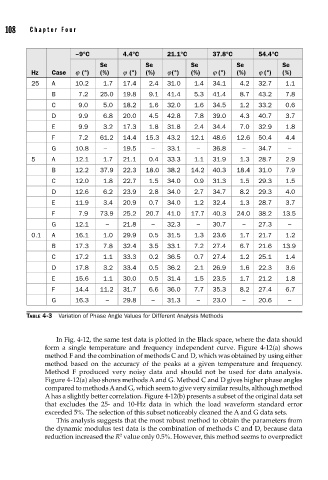
               TABLE 4-3  Variation of Phase Angle Values for Different Analysis Methods


                       In Fig. 4-12, the same test data is plotted in the Black space, where the data should
                    form a single temperature and frequency independent curve. Figure 4-12(a) shows
                    method F and the combination of methods C and D, which was obtained by using either
                    method based on the accuracy of the peaks at a given temperature and frequency.
                    Method F produced very noisy data and should not be used for data analysis.
                    Figure 4-12(a) also shows methods A and G. Method C and D gives higher phase angles
                    compared to methods A and G, which seem to give very similar results, although method
                    A has a slightly better correlation. Figure 4-12(b) presents a subset of the original data set
                    that excludes the 25- and 10-Hz data in which the load waveform standard error
                    exceeded 5%. The selection of this subset noticeably cleaned the A and G data sets.
                       This analysis suggests that the most robust method to obtain the parameters from
                    the dynamic modulus test data is the combination of methods C and D, because data
                                         2
                    reduction increased the R  value only 0.5%. However, this method seems to overpredict

