


Page 131 - MODELING OF ASPHALT CONCRETE
P. 131
Complex Modulus Characterization of Asphalt Concr ete      109


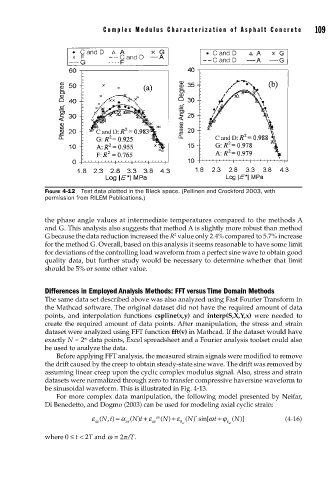
                    FIGURE 4-12  Test data plotted in the Black space. (Pellinen and Crockford 2003, with
                    permission from RILEM Publications.)


                    the phase angle values at intermediate temperatures compared to the methods A
                    and G. This analysis also suggests that method A is slightly more robust than method
                                                         2
                    G because the data reduction increased the R  value only 2.4% compared to 5.7% increase
                    for the method G. Overall, based on this analysis it seems reasonable to have some limit
                    for deviations of the controlling load waveform from a perfect sine wave to obtain good
                    quality data, but further study would be necessary to determine whether that limit
                    should be 5% or some other value.


                    Differences in Employed Analysis Methods: FFT versus Time Domain Methods
                    The same data set described above was also analyzed using Fast Fourier Transform in
                    the Mathcad software. The original dataset did not have the required amount of data
                    points, and interpolation functions  cspline(x,y) and  interp(S,X,Y,x) were needed to
                    create the required amount of data points. After manipulation, the stress and strain
                    dataset were analyzed using FFT function fft(v) in Mathcad. If the dataset would have
                               m
                    exactly N = 2  data points, Excel spreadsheet and a Fourier analysis toolset could also
                    be used to analyze the data.
                       Before applying FFT analysis, the measured strain signals were modified to remove
                    the drift caused by the creep to obtain steady-state sine wave. The drift was removed by
                    assuming linear creep upon the cyclic complex modulus signal. Also, stress and strain
                    datasets were normalized through zero to transfer compressive haversine waveform to
                    be sinusoidal waveform. This is illustrated in Fig. 4-13.
                       For more complex data manipulation, the following model presented by Neifar,
                    Di Benedetto, and Dogmo (2003) can be used for modeling axial cyclic strain:
                                 ε (, =   α ( N t + ε  av ( N) +  ε ( N) sin[ ωt + ϕ ()]  (4-16)
                                                               *
                                              )
                                                                          N
                                    Nt)
                                                          0
                                                  ax
                                           ax
                                  ax
                                                           ax           ε aax
                                          π
                    where 0 ≤ t < 2T and ω = 2/T.

