


Page 135 - MODELING OF ASPHALT CONCRETE
P. 135
Complex Modulus Characterization of Asphalt Concr ete      113


                       The justification of using a sigmoidal function for fitting the compressive dynamic
                    modulus data is based on the physical observations of the mix behavior. The upper part
                    of the sigmoidal function approaches asymptotically to the maximum stiffness of the mix,
                    which is dependent on the limiting binder stiffness (glassy modulus) at cold temperatures.
                    At high temperatures, the compressive loading causes aggregate influence to be more
                    dominant than the viscous binder influence causing mix stiffness to approach a limiting
                    equilibrium value, which is dependent of the aggregate gradation. Thus, the sigmoidal
                    function captures the physical behavior of the asphalt mixtures observed in the mechanical
                    testing using compressive cyclic loading through the entire temperature range.
                       The advantage of using the sigmoidal fitting function is that a mastercurve can be
                    constructed using Excel spreadsheets and Solver Function. The Solver Function is a
                    tool for performing nonlinear least squares regression in the Excel spreadsheet.
                    However, it should be noted that if the dataset does not include modulus values for
                    full temperature range, caution should be used if the sigmoidal function is employed
                    in the mastercurve construction. One way is to confine the asymptotic high and low
                    modulus values to some assumed default values. Then, the asymptotic parameter
                    values d and d +a need to be constrained to proper modulus values to obtain adequate
                    mastercurve.
                       Witczak et al. (Fonseca and Witczak 1996;  Andrei et al. 1999) introduced the
                    sigmoidal function to model the behavior of asphalt mixtures in conjunction with the
                    dynamic modulus predictive equation, which predicts mixture stiffness from volumetric
                    and raw material information.

                    Stress-Dependent Mastercurve for HMA
                    The stiffness of the hot mix asphalt (HMA) varies as a function of test temperature and
                    loading frequency as discussed above, however, the applied stress levels also affect the
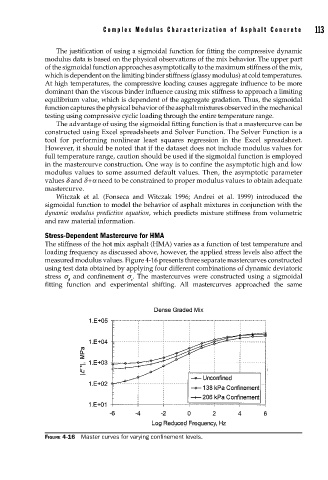
                    measured modulus values. Figure 4-16 presents three separate mastercurves constructed
                    using test data obtained by applying four different combinations of dynamic deviatoric
                    stress  s  and confinement  s . The mastercurves were constructed using a sigmoidal
                           d                c
                    fitting function and experimental shifting.  All mastercurves approached the same


                    FIGURE 4-16  Master curves for varying confi nement levels.

