


Page 134 - MODELING OF ASPHALT CONCRETE
P. 134
112    Cha pte r  F o u r


                    the mastercurve. For time or frequency dependency, the generalized power law has
                    been used at low to intermediate temperatures when shifting creep or relaxation test
                    data for asphalt mixtures (Rogue and Buttlar 1992; Christensen 1998). As the higher
                    temperature data is included, polynomial fitting functions have been used to capture
                    the form of mastercurve initiated by the material behavior (Francken and Verstraeten
                    1998). Gordon and Shaw (1994) have used piecewise fitting of polynomial functions
                    through the test data to construct a mastercurve. Rowe and Sharrock (2000) have
                    modified this approach by adding the cubic spline method to shift the data to the
                    reference temperature.

                    Experimental Shifting and Sigmoidal Fitting Function
                    A study by Pellinen, Witczak, and Bonaquist (2002) and Pellinen (2001) developed a
                    method of constructing the full mastercurve using an “experimental” shifting technique
                    using a sigmoidal fitting function. The experimental shift solves shift factors
                    simultaneously with the coefficients of the fitting function. In this way the form of the
                    shift function is not forced to the mastercurve. However, shift factors may absorb some
                    of the experimental error from the test data.
                       As mentioned earlier, polynomial fitting functions have been used to shift the
                    asphalt mix test data using piecewise fitting approach. However, a single polynomial
                    model cannot be used for fitting the whole mastercurve because the polynomial swing
                    at low and high temperatures causes irrational modulus value predictions when
                    extrapolating outside the range of data. To avoid this problem a new functional form,
                    sigmoidal function Eq. (4-18), was selected to fit the dynamic modulus test data obtained
                    from temperatures ranging from −18°C to 55°C.
                                                              α
                                             log(|E ∗ |) = δ +  βγ  ξ                   (4-18)
                                                               −
                                                          1 +  e  log( )
                            ∗
                    where |E | = dynamic modulus
                             x = reduced frequency
                             d = minimum modulus value
                             a = span of modulus values
                           b, g = shape parameters

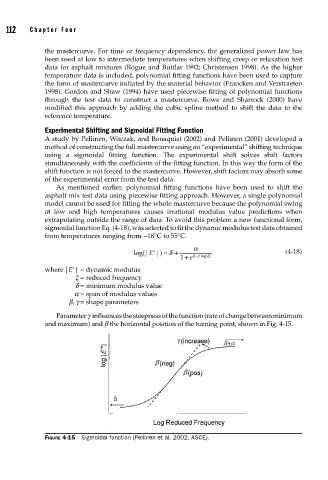
                       Parameterg influences the steepness of the function (rate of change between minimum
                    and maximum) and b the horizontal position of the turning point, shown in Fig. 4-15.


                    FIGURE 4-15  Sigmoidal function (Pellinen et al. 2002, ASCE).

