


Page 132 - Modern Control Systems
P. 132
106              Chapter 2  Mathematical  Models of  Systems

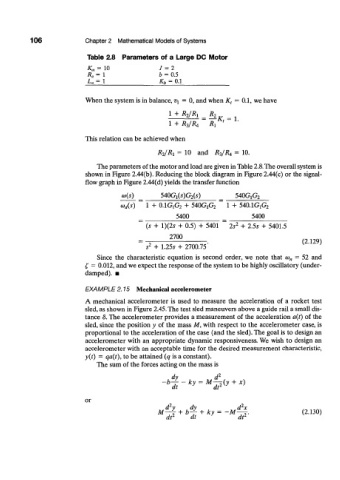
                            Table 2.8  Parameters  of a  Large  DC Motor
                               =  10              /  =  2
                            K m
                              = 1                 b =  0.5
                            R a
                              = \                   = 0.1
                            L a                   K b
                           When the system is in balance, Vi  =  0, and when  K (  =  0.1, we have

                                                     1  +  *2/*l  _  *2  -  =  i
                                                     l  +  i? 3/i?4  *1  '  '

                           This relation  can be achieved  when

                                                 R 2(Ri  =  10  and  R 3/R 4  =  10.
                               The parameters  of the motor and load are given in Table 2.8. The overall system is
                           shown  in Figure 2.44(b). Reducing the block  diagram  in Figure 2.44(c) or the  signal-
                           flow graph in Figure 2.44(d) yields the transfer  function

                                      <o(s)       540Gi(s)G 2(s)         540GxG 2
                                      co d(s)  1  +  O . I G ^  +  540GxG 2  1  +  5 4 0 . ^ ^
                                                       5400                   5400
                                              (s  +  1)(25  +  0.5)  +  5401  Is 1  +  2.5s  +  5401.5
                                                     2700
                                                                                             (2.129)
                                              s 2  +  1.255  +  2700.75'
                               Since  the  characteristic  equation  is  second  order,  we  note  that  <o n  =  52  and
                           £  =  0.012, and we expect the response of the system to be highly oscillatory  (under-
                           damped).  •

                           EXAMPLE   2.15  Mechanical  accelerometer

                           A  mechanical  accelerometer  is  used  to  measure  the  acceleration  of  a  rocket  test
                           sled, as shown  in Figure 2.45. The test sled maneuvers above  a guide rail a small dis-
                           tance  5. The  accelerometer  provides  a measurement  of  the  acceleration  a{t)  of  the
                           sled, since the  position  y  of  the  mass  M,  with  respect  to  the  accelerometer  case, is
                           proportional  to the  acceleration  of the  case  (and  the  sled). The  goal  is to  design  an
                           accelerometer  with  an  appropriate  dynamic  responsiveness. We  wish  to  design  an
                           accelerometer  with  an  acceptable  time  for  the  desired measurement  characteristic,
                           y{t)  =  qa{t),  to be attained  (q is a constant).
                               The sum  of the forces  acting on the mass is
                                                     dy_
                                                   -b±  -ky J  =  M-t(y  + x)
                                                     dt   "     '"  df

                           or
                                                                           2
                                                    l
                                                    d /2„ y  dy  t     ^ r  d Alx
                                                           J„
                                                 M-~r 2  +  b-r  +  ky  =  -M—ir.            (2.130)
                                                    dt     dt    *        df

