


Page 161 - Modern Control Systems
P. 161
Exercises                                                           135

                       h.  Laplace  transform  Unidirectional, operational blocks that represent  the
                                           transfer functions  of the elements of the system.
                        i.  Linear         A rule that enables the user to obtain a transfer
                          approximation    function  by tracing paths and loops within a system.
                        j .  Linear system   An electric actuator  that uses an input voltage as
                                           a control variable.
                       k.  Mason loop rule   The ratio  of the Laplace transform  of the  output
                                           variable to the Laplace transform  of the input variable.
                        1.  Mathematical   Descriptions  of the behavior  of a system using
                          models          mathematics.
                                          A  model of a system that is used to investigate the
                       m.  Signal-flow  graph  behavior  of a system  by utilizing actual input signals.
                                           A diagram that consists  of nodes connected  by several
                       n.  Simulation     directed branches and that is a graphical  representation
                                          of a set of linear relations.
                       o.  Transfer  function  An approximate model that results in a linear  relationship
                                          between the output  and the input  of the device.


       EXERCISES

      Exercises are straightforward  applications  of  the  concepts
      of the chapter.
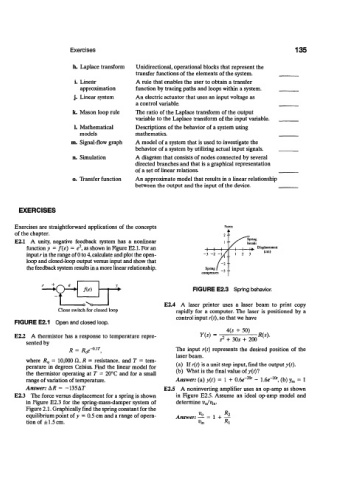
      E2.1  A  unity,  negative  feedback  system  has  a  nonlinear        Spring
                                                                            breaks
                         2
         function  y  = /(e)  =  e , as shown in Figure E2.1. For an   H—I—h   I  fc  Displacement
         input r in the range of 0 to 4, calculate and plot the open-        "™'  (em)
         loop and closed-loop output versus input and show that
         the feedback system results in a more linear relationship.   Springf
                                                               compresses
                                                            FIGURE E2.3  Spring behavior.

                                                   E2.4  A  laser  printer  uses  a  laser  beam  to  print  copy
                   Close switch for closed loop        rapidly  for  a  computer. The  laser  is positioned  by  a
                                                       control input r(t), so that we have
      FIGURE E2.1  Open and closed loop.
                                                                      4(s  +  50)
      E2.2  A  thermistor  has a response  to temperature  repre-  7 ( 5 ) -  s 2  +  30s  +  200  R(s).
         sented by
                        =  /^-01-^                     The  input  r(t)  represents  the  desired  position  of  the
                      R
                                                       laser beam.
         where  R 0  =  10,000 ft, R  =  resistance,  and  T  =  tem-
         perature  in  degrees  Celsius. Find  the  linear  model  for  (a)  If r(t)  is a unit step input, find the output  y(t).
         the  thermistor  operating  at  T  =  20°C and  for  a  small  (b)  What is the final value of  y{t)l
                                                                                     10
                                                                             20
         range of variation  of temperature.           Answer:  (a) y{t)  =  1 +  0.6<T '  -  1.6<T ', (b) y ss  =  1
         Answer:  AR  =  -135AF                    E2.5  A noninverting  amplifier  uses an op-amp as shown
      E2.3  The force  versus displacement  for  a spring is shown   in  Figure  E2.5. Assume  an  ideal  op-amp  model  and
         in Figure E2.3 for  the  spring-mass-damper  system  of  determine  v 0/v m.
         Figure 2.1. Graphically find the spring constant for the
         equilibrium point of y  =  0.5 cm and a range  of opera-
                                                       Answer:  —  -  1 +  —
         tion  of ±1.5 cm.

