


Page 177 - Modular design for machine tools
P. 177
Application of Machine Tool Description to Engineering  Design    137

               extended functional description contains more detailed information for
               the possible  form-generating functions [6]. As shown in Fig. 4-4, the
               machining procedures, which are carried out by the horizontal boring
               and milling machine, can be completely extracted from the extended
               functional description. In fact, the extended description can, in princi-
               ple, represent more details of the form-generating function by consid-
               ering the combination of movements and clarifying the direct relation
               to the  well-known machining methods. In addition, a variant of
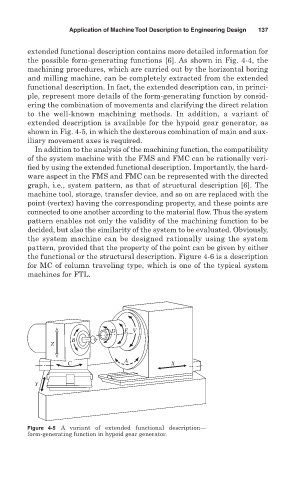
               extended description is available for the hypoid gear generator, as
               shown in Fig. 4-5, in which the dexterous combination of main and aux-
               iliary movement axes is required.
                 In addition to the analysis of the machining function, the compatibility
               of the system machine with the FMS and FMC can be rationally veri-
               fied by using the extended functional description. Importantly, the hard-
               ware aspect in the FMS and FMC can be represented with the directed
               graph, i.e., system pattern, as that of structural description [6]. The
               machine tool, storage, transfer device, and so on are replaced with the
               point (vertex) having the corresponding property, and these points are
               connected to one another according to the material flow. Thus the system
               pattern enables not only the validity of the machining function to be
               decided, but also the similarity of the system to be evaluated. Obviously,
               the system machine can be designed rationally using the system
               pattern, provided that the property of the point can be given by either
               the functional or the structural description. Figure 4-6 is a description
               for MC of column traveling type, which is one of the typical system
               machines for FTL.


                                      D  E V
                           B
                      Z
                                          A
                          C                           X

                 Y


               Figure 4-5    A variant of extended functional description—
               form-generating function in hypoid gear generator.

