


Page 182 - Modular design for machine tools
P. 182
142   Modular Design Guide and Machine Tools Description

                 In short, the concept and layout design can be performed by even imma-
               ture designers using the functional description, data file to convert the
               machining method symbol to FGF, and logic operation, although the dimen-
               sional specifications cannot be given. In this context, it is worth consider-
               ing the research of Saljé and Redeker [8], which can deal with the
               generation of a group of the machine tools available for the manufactur-
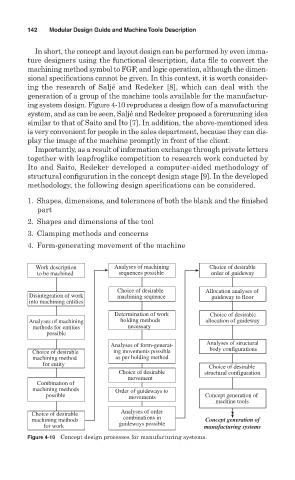
               ing system design. Figure 4-10 reproduces a design flow of a manufacturing
               system, and as can be seen, Saljé and Redeker proposed a forerunning idea
               similar to that of Saito and Ito [7]. In addition, the  above-mentioned idea
               is very convenient for people in the sales department, because they can dis-
               play the image of the machine promptly in front of the client.
                 Importantly, as a result of information exchange through private letters
               together with leapfroglike competition to research work conducted by
               Ito and Saito, Redeker developed a  computer- aided methodology of
               structural configuration in the concept design stage [9]. In the developed
               methodology, the following design specifications can be  considered.
               1. Shapes, dimensions, and tolerances of both the blank and the finished
                  part
               2. Shapes and dimensions of the  tool
               3. Clamping methods and  concerns
               4.  Form-generating movement of the machine


                  Work description     Analyses of machining    Choice of desirable
                   to be machined         sequences possible     order of guideway

                                        Choice of desirable    Allocation analyses of
                Disintegration of work  machining sequence         guideway to floor
                into machining entities
                                       Determination of work      Choice of desirable
                Analyses of machining       holding methods    allocation of guideway
                 methods for entities            necessary
                     possible
                                      Analyses of form-generat-  Analyses of structural
                 Choice of desirable   ing movements possible    body configurations
                 machining method      as per holding method
                        for entity
                                                                  Choice of desirable
                                        Choice of desirable    structural configuration
                                              movement
                    Combination of
                 machining methods     Order of guideways to
                          possible              movements      Concept generation of
                                                                      machine tools
                                         Analyses of order
                 Choice of desirable
                 machining methods       combinations in       Concept generation of
                         for work       guideways possible     manufacturing systems
               Figure 4-10    Concept design processes for manufacturing systems.

