


Page 183 - Modular design for machine tools
P. 183
Application of Machine Tool Description to Engineering  Design    143

                 The allowable structural configuration can be ascertained after judg-
               ing the reality of all the possible  form-generating movements to vari-
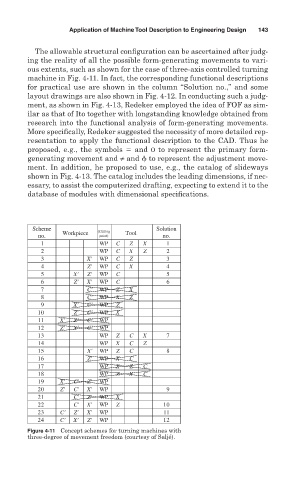
               ous extents, such as shown for the case of  three-axis controlled turning
               machine in Fig. 4-11. In fact, the corresponding functional descriptions
               for practical use are shown in the column “Solution no.,” and some
               layout drawings are also shown in Fig. 4-12. In conducting such a judg-
               ment, as shown in Fig. 4-13, Redeker employed the idea of FOF as sim-
               ilar as that of Ito together with longstanding knowledge obtained from
               research into the functional analysis of  form-generating movements.
               More specifically, Redeker suggested the necessity of more detailed rep-
               resentation to apply the functional description to the CAD. Thus he
               proposed, e.g., the symbols   and O to represent the primary  form-
               generating movement and ≠ and   to represent the adjustment move-
               ment. In addition, he proposed to use, e.g., the catalog of slideways
               shown in Fig. 4-13. The catalog includes the leading dimensions, if nec-
               essary, to assist the computerized drafting, expecting to extend it to the
               database of modules with dimensional specifications.


                 Scheme           (Cutting        Solution
                  no.    Workpiece  point)  Tool    no.
                   1               WP  C   Z   X     1
                   2               WP  C   X   Z     2
                   3           X'  WP  C   Z         3
                   4            Z'  WP  C  X         4
                   5        X'  Z'  WP  C            5
                   6        Z'  X'  WP  C            6
                   7           C'  WP  Z   X
                   8           C'  WP  X   Z
                   9        X'  C'  WP  Z
                  10        Z'  C'  WP  X
                  11    X'  Z'  C'  WP
                  12    Z'  X'  C'  WP
                  13               WP  Z   C   X     7
                  14               WP  X   C   Z
                  15           X'  WP  Z   C         8
                  16            Z'  WP  X  C
                  17               WP  X   Z   C
                  18               WP  Z   X   C
                  19    X'  C'  Z'  WP
                  20    Z'  C'  X'  WP               9
                  21        C'  Z'  WP  X
                  22        C'  X'  WP  Z           10
                  23    C'  Z'  X'  WP              11
                  24    C'  X'  Z'  WP              12
               Figure 4-11    Concept schemes for turning machines with
               three-degree of movement freedom (courtesy of Saljé).

