


Page 181 - Modular design for machine tools
P. 181
Application of Machine Tool Description to Engineering  Design    141


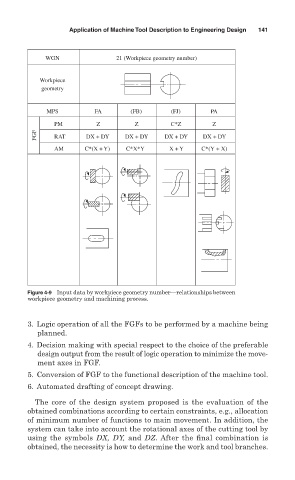
                    WGN                21 (Workpiece geometry number)

                   Workpiece
                   geometry

                     MPS         FA        (FB)       (FJ)       PA

                       PM         Z         Z         C*Z        Z
                  FGF  RAT     DX + DY    DX + DY   DX + DY    DX + DY

                       AM      C*(X + Y)  C*X*Y       X + Y   C*(Y + X)


               Figure 4-9    Input data by workpiece geometry  number—relationships between
               workpiece geometry and machining process.


               3. Logic operation of all the FGFs to be performed by a machine being
                  planned.
               4. Decision making with special respect to the choice of the preferable
                  design output from the result of logic operation to minimize the move-
                  ment axes in FGF.
               5. Conversion of FGF to the functional description of the machine  tool.
               6. Automated drafting of concept drawing.
                 The core of the design system proposed is the evaluation of the
               obtained combinations according to certain constraints, e.g., allocation
               of minimum number of functions to main movement. In addition, the
               system can take into account the rotational axes of the cutting tool by
               using the symbols DX, DY, and DZ. After the final combination is
               obtained, the necessity is how to determine the work and tool  branches.

