


Page 285 - Modular design for machine tools
P. 285
244   Engineering Design for Machine Tool Joints

                  0.15


                 Tangential force ratio m τ  0.1


                                     Arranged from data
                  0.05
                                      of Courtney-Pratt
                                        and Eisner


                     0         0.05       0.1        0.15
                               Displacement d , mm
                                         s
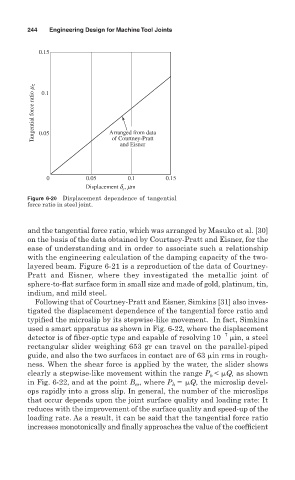
               Figure 6-20  Displacement dependence of tangential
               force ratio in steel joint.


               and the tangential force ratio, which was arranged by Masuko et al. [30]
               on the basis of the data obtained by  Courtney-Pratt and Eisner, for the
               ease of understanding and in order to associate such a relationship
               with the engineering calculation of the damping capacity of the  two-
               layered beam. Figure 6-21 is a reproduction of the data of  Courtney-
               Pratt and Eisner, where they investigated the metallic joint of
               sphere-to-flat surface form in small size and made of gold, platinum, tin,
               indium, and mild steel.
                 Following that of Courtney-Pratt and Eisner, Simkins [31] also inves-
               tigated the displacement dependence of the tangential force ratio and
               typified the microslip by its  stepwise-like movement.  In fact, Simkins
               used a smart apparatus as shown in Fig. 6-22, where the displacement
               detector is of fiber- optic type and capable of resolving 10  7   in, a steel
               rectangular slider weighing 653 gr can travel on the  parallel-piped
               guide, and also the two surfaces in contact are of 63  in rms in rough-
               ness. When the shear force is applied by the water, the slider shows
               clearly a stepwise-like movement within the range P <  Q, as shown
                                                                h
               in Fig. 6-22, and at the point B , where P   Q, the microslip devel-
                                                      h
                                            cr
               ops rapidly into a gross slip. In general, the number of the microslips
               that occur depends upon the joint surface quality and loading rate: It
               reduces with the improvement of the surface quality and  speed-up of the
               loading rate. As a result, it can be said that the tangential force ratio
               increases monotonically and finally approaches the value of the coefficient

