


Page 280 - Modular design for machine tools
P. 280
Engineering Design Fundamentals and Single Flat Joint Characteristics        239


                                                             0.4

                  20

                                K s                              mm
                 Tangential joint stiffness K s , kgf/mm  10  Joint material: BsBM2  max  = 2.2 mm  0.2  Microslip d r ,


                                 Joint surface: ground, R
                                             d
                                              r
                                          K s
                                                     P
                                  d
                                                     P
                                  r

                   0                                         0
                               200          400          600
                                 Normal preload Q, kgf
                                       (b)
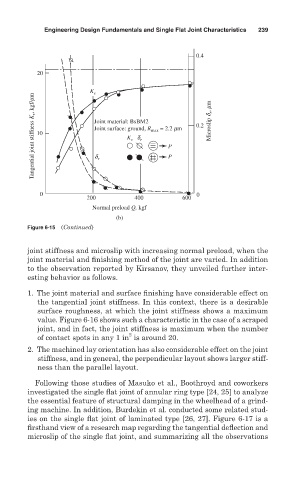
               Figure 6-15 (Continued)


               joint stiffness and microslip with increasing normal preload, when the
               joint material and finishing method of the joint are varied. In addition
               to the observation reported by Kirsanov, they unveiled further inter-
               esting behavior as follows.

               1. The joint material and surface finishing have considerable effect on
                  the tangential joint stiffness. In this context, there is a desirable
                  surface roughness, at which the joint stiffness shows a maximum
                  value. Figure 6-16 shows such a characteristic in the case of a scraped
                  joint, and in fact, the joint stiffness is maximum when the number
                                           2
                  of contact spots in any 1 in is around 20.
               2. The machined lay orientation has also considerable effect on the joint
                  stiffness, and in general, the perpendicular layout shows larger stiff-
                  ness than the parallel layout.

                 Following those studies of Masuko et al., Boothroyd and coworkers
               investigated the single flat joint of annular ring type [24, 25] to analyze
               the essential feature of structural damping in the wheelhead of a grind-
               ing machine. In addition, Burdekin et al. conducted some related stud-
               ies on the single flat joint of laminated type [26, 27]. Figure 6-17 is a
               firsthand view of a research map regarding the tangential deflection and
               microslip of the single flat joint, and summarizing all the observations

