


Page 292 - Modular design for machine tools
P. 292
Engineering Design Fundamentals and Single Flat Joint Characteristics        251

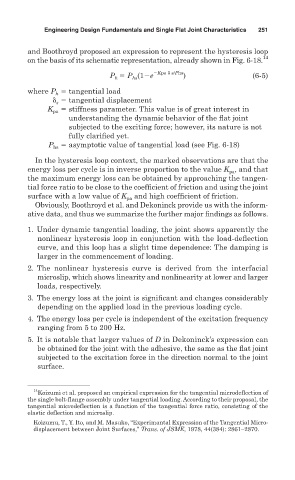
               and Boothroyd proposed an expression to represent the hysteresis loop
               on the basis of its schematic representation, already shown in Fig. 6-18. 14
                                                  Kpa
 s/Phs
                                      P h   P hs (1 e    )                  (6-5)
               where P h   tangential load

 s   tangential displacement
                     K pa   stiffness parameter. This value is of great interest in
                           understanding the dynamic behavior of the flat joint
                           subjected to the exciting force; however, its nature is not
                           fully clarified yet.
                          asymptotic value of tangential load (see Fig. 6-18)
                     P hs
                 In the hysteresis loop context, the marked observations are that the
               energy loss per cycle is in inverse proportion to the value K , and that
                                                                      pa
               the maximum energy loss can be obtained by approaching the tangen-
               tial force ratio to be close to the coefficient of friction and using the joint
               surface with a low value of K pa  and high coefficient of friction.
                 Obviously, Boothroyd et al. and Dekoninck provide us with the inform-
               ative data, and thus we summarize the further major findings as follows.
               1. Under dynamic tangential loading, the joint shows apparently the
                  nonlinear hysteresis loop in conjunction with the  load-deflection
                  curve, and this loop has a slight time dependence: The damping is
                  larger in the commencement of loading.
               2. The nonlinear hysteresis curve is derived from the interfacial
                  microslip, which shows linearity and nonlinearity at lower and larger
                  loads, respectively.
               3. The energy loss at the joint is significant and changes considerably
                  depending on the applied load in the previous loading cycle.
               4. The energy loss per cycle is independent of the excitation frequency
                  ranging from 5 to 200 Hz.
               5. It is notable that larger values of D in Dekoninck’s expression can
                  be obtained for the joint with the adhesive, the same as the flat joint
                  subjected to the excitation force in the direction normal to the joint
                  surface.


                 14
                  Koizumi et al. proposed an empirical expression for the tangential microdeflection of
               the single bolt-flange assembly under tangential loading. According to their proposal, the
               tangential microdeflection is a function of the tangential force ratio, consisting of the
               elastic deflection and microslip.
                 Koizumu, T., Y. Ito, and M. Masuko, “Experimantal Expression of the Tangential  Micro-
                 displacement between Joint Surfaces,” Trans. of JSME, 1978, 44(384): 2861–2870.

