


Page 295 - Modular design for machine tools
P. 295
254   Engineering Design for Machine Tool Joints


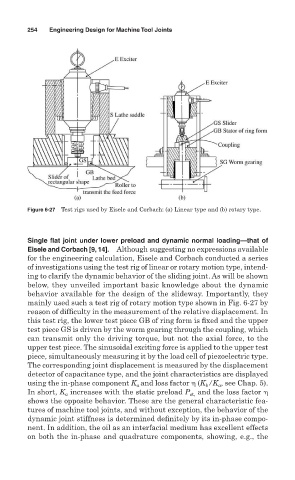
               Figure 6-27 Test rigs used by Eisele and Corbach: (a) Linear type and (b) rotary type.


               Single flat joint under lower preload and dynamic normal loading—that of
               Eisele and Corbach [9, 14]. Although suggesting no expressions available
               for the engineering calculation, Eisele and Corbach conducted a series
               of investigations using the test rig of linear or rotary motion type, intend-
               ing to clarify the dynamic behavior of the sliding joint. As will be shown
               below, they unveiled important basic knowledge about the dynamic
               behavior available for the design of the slideway. Importantly, they
               mainly used such a test rig of rotary motion type shown in Fig. 6-27 by
               reason of difficulty in the measurement of the relative displacement. In
               this test rig, the lower test piece GB of ring form is fixed and the upper
               test piece GS is driven by the worm gearing through the coupling, which
               can transmit only the driving torque, but not the axial force, to the
               upper test piece. The sinusoidal exciting force is applied to the upper test
               piece, simultaneously measuring it by the load cell of piezoelectric type.
               The corresponding joint displacement is measured by the displacement
               detector of capacitance type, and the joint characteristics are displayed
               using the in-phase component K and loss factor   (K /K , see Chap. 5).
                                                                   a
                                                               b
                                             a
               In short, K increases with the static preload P st,  and the loss factor
                          a
               shows the opposite behavior. These are the general characteristic fea-
               tures of machine tool joints, and without exception, the behavior of the
               dynamic joint stiffness is determined definitely by its  in-phase compo-
               nent. In addition, the oil as an interfacial medium has excellent effects
               on both the  in-phase and quadrature components, showing, e.g., the

