


Page 291 - Modular design for machine tools
P. 291
250   Engineering Design for Machine Tool Joints

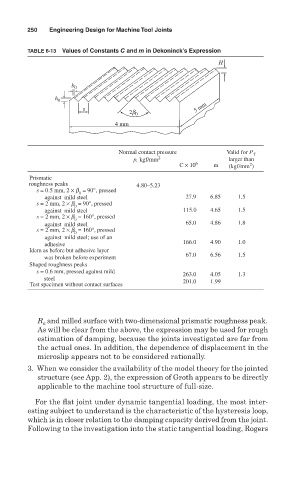
               TABLE 6-13 Values of Constants C and m in Dekoninck’s Expression
                                                                   H


                           b 0
                       h 0
                              s                              5 mm
                                           2b 0
                                       4 mm


                                        Normal contact pressure      Valid for P t
                                            p, kgf/mm 2               larger than
                                                                           2
                                                        C × 10 6  m   (kgf/mm )
                Prismatic
                roughness peaks              4.80–5.23
                  s = 0.5 mm, 2 × b  = 90°, pressed
                             0
                    against  mild steel                   27.9   6.85   1.5
                  s = 2 mm, 2 × b  = 90°, pressed
                            0
                    against  mild steel                  115.0   4.65   1.5
                  s = 2 mm, 2 × b  = 160°, pressed
                            0
                    against  mild steel                   65.0   4.86   1.8
                  s = 2 mm, 2 × b  = 160°, pressed
                            0
                    against  mild steel; use of an
                                                         166.0   4.90   1.0
                    adhesive
                Idem as before but adhesive layer
                                                          67.0   6.56   1.5
                          was broken before experiment
                Shaped roughness peaks
                  s = 0.6 mm, pressed against mild
                                                         263.0   4.05   1.3
                       steel
                Test specimen without contact surfaces   201.0   1.99
                  R and milled surface with  two-dimensional prismatic roughness peak.
                    a
                  As will be clear from the above, the expression may be used for rough
                  estimation of damping, because the joints investigated are far from
                  the actual ones. In addition, the dependence of displacement in the
                  microslip appears not to be considered rationally.
               3. When we consider the availability of the model theory for the jointed
                  structure (see App. 2), the expression of Groth appears to be directly
                  applicable to the machine tool structure of full-size.
                 For the flat joint under dynamic tangential loading, the most inter-
               esting subject to understand is the characteristic of the hysteresis loop,
               which is in closer relation to the damping capacity derived from the joint.
               Following to the investigation into the static tangential loading, Rogers

