


Page 280 - Origin and Prediction of Abnormal Formation Pressures
P. 280
252                                  H.H. RIEKE, G.V. CHILINGAR AND J.O. ROBERTSON JR.

                            +           A
                200

            n
             E   ]50
            =4.-=.
             (1)           2                                    I              B
             0                                 100              2
             >
            = ,,,.m         3
                100
             O"

             E   5o                         1~"  4o

                                            i~   20              4
                     . . . .  4   ._,,,._~.      L
                     0   .  .  .  .  ~  ~  5
                  0   . . . . . . . .  '  .....   E   0      -,-.-,--
                   70  60  50  40  30  20   10   0   200   150     1 O0     50
                     "     %  H20                             %/-/20
                     -
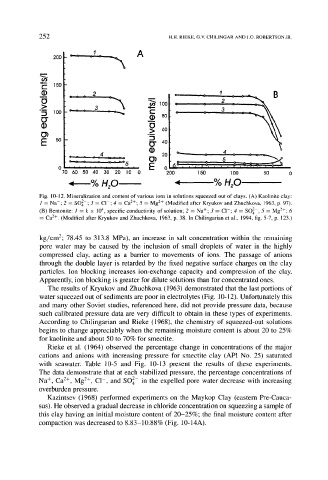
            Fig.  10-12.  Mineralization  and  content  of various  ions  in  solutions  squeezed  out  of clays.  (A)  Kaolinite  clay:
            1  --  Na +"  2  =  SO]-"  3  =  CI-'  4  --  Ca 2+"  5  =  Mg 2+  (Modified  after  Kryukov  and  Zhuchkova,  1963,  p.  97).
            (B)  Bentonite:  1  =  k  x  104,  specific  conductivity  of  solution;  2  -  Na +"  3  =  C1-"  4  --  SO]-;  5  =  Mg 2+"  6
            --  Ca 2+.  (Modified  after  Kryukov  and  Zhuchkova,  1963,  p.  38.  In  Chilingarian  et  al.,  1994,  fig.  5-7,  p.  123.)


            kg/cm2;  78.45  to  313.8  MPa),  an  increase  in  salt  concentration  within  the  remaining
            pore  water  may  be  caused  by  the  inclusion  of  small  droplets  of  water  in  the  highly
            compressed  clay,  acting  as  a  barrier  to  movements  of  ions.  The  passage  of  anions
            through  the  double  layer  is  retarded  by  the  fixed  negative  surface  charges  on  the  clay
            particles.  Ion  blocking  increases  ion-exchange  capacity  and  compression  of  the  clay.
            Apparently, ion blocking is greater for dilute solutions  than for concentrated ones.
               The results of Kryukov and Zhuchkova  (1963)  demonstrated  that the  last portions  of
            water squeezed out of sediments are poor in electrolytes (Fig.  10-12).  Unfortunately this
            and many  other  Soviet  studies,  referenced  here,  did  not  provide  pressure  data,  because
            such  calibrated pressure  data  are  very difficult  to  obtain  in  these  types  of experiments.
            According  to  Chilingarian  and  Rieke  (1968),  the  chemistry  of  squeezed-out  solutions
            begins  to change  appreciably  when  the  remaining  moisture  content  is  about 20 to 25%
            for kaolinite and about 50 to 70% for smectite.
               Rieke  et  al.  (1964)  observed  the  percentage  change  in  concentrations  of the  major
            cations  and  anions  with  increasing  pressure  for  smectite  clay  (API  No.  25)  saturated
            with  seawater.  Table  10-5 and  Fig.  10-13  present  the  results  of  these  experiments.
            The  data demonstrate  that  at each  stabilized pressure,  the  percentage  concentrations  of
            Na +,  Ca 2+, Mg 2+,  CI-,  and  SO 2-  in  the  expelled pore  water decrease  with  increasing
            overburden pressure.
               Kazintsev  (1968)  performed  experiments  on  the  Maykop  Clay  (eastern  Pre-Cauca-
            sus). He observed a gradual decrease in chloride concentration on squeezing a sample of
            this  clay having  an initial moisture  content  of 20-25%;  the  final moisture  content after
            compaction was decreased to 8.83-10.88%  (Fig.  10-14A).

