


Page 101 - Photoreactive Organic Thin Films
P. 101
ZOUHEIR SEKKAT

                                  (A)


                                 (B)
                               1,4 -
                               1,2 -
                               1,0
                             c
                             .9. 0,8
                             o.
                             | 0.6
                               0,4
                               0,2
                               0,0
                                 200  250  300  350  400  450  500  550  600  850


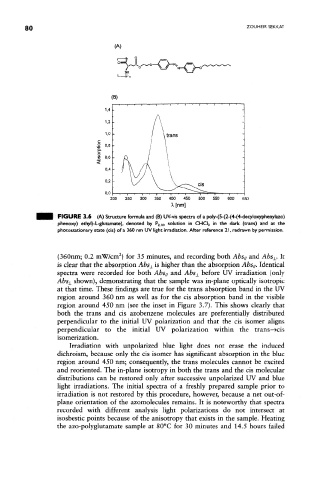
                 FIGURE 3.6 (A) Structure formula and (B) UV-vis spectra of a poly-(5-(2-(4-(4-decyIoxyphenylazo)
                 phenoxy) ethyl)-L-glutamate), denoted by P 2ito, solution in CHCI 3 in the dark (trans) and at the
                 photostationary state (cis) of a 360 nm UV light irradiation. After reference 21, redrawn by permission.


                                   2
                 (360nm; 0.2 mW/cm ) for 35 minutes, and recording both Abs// and Abs ±. It
                 is clear that the absorption Abs ± is higher than the absorption Abs//. Identical
                 spectra were recorded for both Abs// and Ab$ L before UV irradiation (only
                 Abs L shown), demonstrating that the sample was in-plane optically isotropic
                 at that time. These findings are true for the trans absorption band in the UV
                 region around 360 nm as well as for the cis absorption band in the visible
                 region around 450 nm (see the inset in Figure 3.7). This shows clearly that
                 both the trans and cis azobenzene molecules are preferentially distributed
                 perpendicular to the initial UV polarization and that the cis isomer aligns
                 perpendicular to the initial UV polarization within the trans—»cis
                 isornerization.
                     Irradiation with unpolarized blue light does not erase the induced
                 dichroism, because only the cis isomer has significant absorption in the blue
                 region around 450 nm; consequently, the trans molecules cannot be excited
                 and reoriented. The in-plane isotropy in both the trans and the cis molecular
                 distributions can be restored only after successive unpolarized UV and blue
                 light irradiations. The initial spectra of a freshly prepared sample prior to
                 irradiation is not restored by this procedure, however, because a net out-of-
                 plane orientation of the azomolecules remains. It is noteworthy that spectra
                 recorded with different analysis light polarizations do not intersect at
                 isosbestic points because of the anisotropy that exists in the sample. Heating
                 the azo-polyglutamate sample at 80°C for 30 minutes and 14.5 hours failed

