


Page 97 - Photoreactive Organic Thin Films
P. 97
ZOUHE1R SEKKAT

                               a = a 0 exp(-&£),  A% = A^o exp[-(fe + /

                        1-a   An          A  {     <*0 ^ Q    w
                              AA = exp(-kgt) \1 +  t     A   T^  (1 exp(-feH)) , (3.11)
                              /i Mio         [       o A n 0  ^
                                        kA-k$     J
                                            K.£)
                                        K.£)
                                                    1 A B
                                 F = 1
                                               , and J^>  = n(« + 1)D
                 where          r = 1 -    : , and &n'  = «(« + 'nr A B
                                                       8
                                           k
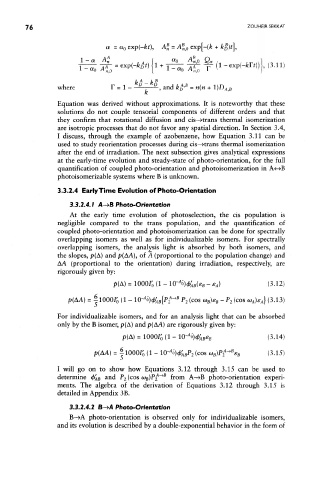
                 Equation was derived without approximations. It is noteworthy that these
                 solutions do not couple tensorial components of different orders and that
                 they confirm that rotational diffusion and cis-»trans thermal isomerization
                 are isotropic processes that do not favor any spatial direction. In Section 3.4,
                 I discuss, through the example of azobenzene, how Equation 3.11 can be
                 used to study reorientation processes during cis— »trans thermal isomerization
                 after the end of irradiation. The next subsection gives analytical expressions
                 at the early-time evolution and steady-state of photo-orientation, for the full
                 quantification of coupled photo-orientation and photoisomerization in A«-»B
                 photoisomerizable systems where B is unknown.
                 3.3.2.4 Early Time Evolution of Photo-Orientation
                     3.3.2.4. / A->B Photo-Orientation
                     At the early time evolution of photoselection, the cis population is
                 negligible compared to the trans population, and the quantification of
                 coupled photo-orientation and photoisomerization can be done for spectrally
                 overlapping isomers as well as for individualizable isomers. For spectrally
                 overlapping isomers, the analysis light is absorbed by both isomers, and
                 the slopes, p(A) and p(AA), of A (proportional to the population change) and
                 AA (proportional to the orientation) during irradiation, respectively, are
                 rigorously given by:
                                                     A
                                               I - 10- o)^ B( % -  £A)         (3.12)
                                                   B
                                               B{P^  P 2 (cos a> B} SB - P 2 (cos a> A)e A] (3.13)
                 For individualizable isomers, and for an analysis light that can be absorbed
                 only by the B isomer, p(A) and p(AA) are rigorously given by:
                                    p(A) = lOOOfo (1 - KHo)^^                  (3.14)

                                                   A               A
                            p(AA) = |lOOOJS (1 - 10~ o)^ BP 2 (cos o» B)P 2 -*%  (3.15)
                 I will go on to show how Equations 3.12 through 3.15 can be used to
                                                8
                 determine <^B and P 2 (cos wg)?^"*  from A-»B photo-orientation experi-
                 ments. The algebra of the derivation of Equations 3.12 through 3.15 is
                 detailed in Appendix 3B.

                     3.3.2.4.2 B-^A Photo-Orientation
                     B— >A photo-orientation is observed only for individualizable isomers,
                 and its evolution is described by a double-exponential behavior in the form of

