


Page 94 - Photoreactive Organic Thin Films
P. 94
3. PHOTO-ORIENTATION BY PHOTOISOMERIZATION                                 73

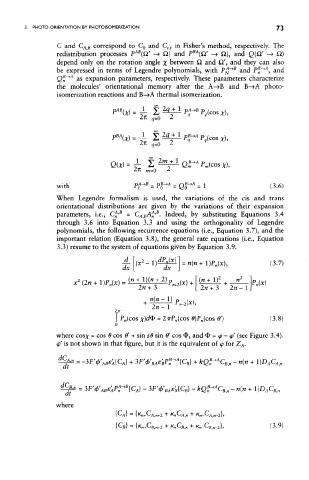
               C and C AjB correspond to C 0 and C c>f in Fisher's method, respectively, The
                                      AB               M
               redistribution processes P (Qf -» O) and P (Q' -> O), and Q(O' '-» O)
               depend only on the rotation angle % between O and O', and they can also
                                                                             A
                                                                   B
               be expressed in terms of Legendre polynomials, with P^  and P®~* , and
                   A
               Qn"~*  as expansion parameters, respectively. These parameters characterize
               the molecules' orientational memory after the A— >B and B~*A photo-
               isomerization reactions and B— »A thermal isomerization.


                                         B      A      A
               with                   P^  = P^  - Q$~*  = 1                   (3.6)
               When Legendre formalism is used, the variations of the cis and trans
               orientational distributions are given by the variations of their expansion
                                A B
                                           A B
               parameters, i.e., C '  = C AjBA ' . Indeed, by substituting Equations 3.4
               through 3.6 into Equation 3.3 and using the orthogonality of Legendre
               polynomials, the following recurrence equations (i.e., Equation 3.7), and the
               important relation (Equation 3.8), the general rate equations (i.e., Equation
               3.3) resume to the system of equations given by Equation 3.9.

                                                                              (3.7)
                                               ax j

                       (2n + l)P n(x) = &±/"
                                        Ltl + J
                                         , n(n — 1) p  / \
                                                  J
                                         "*" ~z  r~  «-2\-*v?
                                           2n~ 1
                                  r
                                  P«(cos x)d® = 2>rrP n(cos 0)P n(cos  tf)    (3.8)
                                 o
               where cos^ = cos B cos tf + sin s& sin ff cos <l>, and $ = <p - <p' (see Figure 3.4).
                f
               (p is not shown in that figure, but it is the equivalent of <p for Z A.
                                                   A
                                                             A
                                                  * {C B} + kQ C B, n - n(n

                                                              A
                                                           B
                                         - 3F'<f>' BAe' B{C B} - kQ ~* C B, n - n(n
               where
                                 {C A} = (K n+Q ;M+2 + K HC Afl + K n_C A, n_ 2},
                                 {C B} = {K w+C BjM+2 + K nC B, n + K n_C B>n_ 2},  (3.9)

