


Page 93 - Photoreactive Organic Thin Films
P. 93
72                                                                ZOUHEIR SEKKAT

                  AB
                               BA
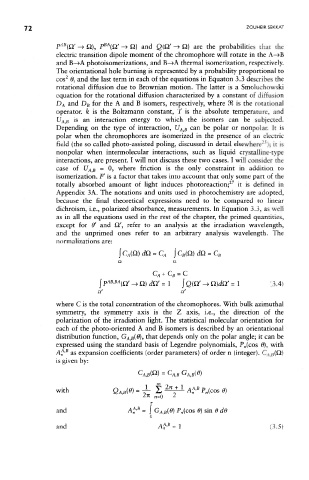
                 F (O' -» O), P (& -> O) and Q(Q' -» O) are the probabilities that the
                 electric transition dipole moment of the chromophore will rotate in the A— >B
                 and B~-»A photoisomerizations, and B— >A thermal isomerization, respectively.
                 The orientational hole burning is represented by a probability proportional to
                   2
                 cos  0, and the last term in each of the equations in Equaton 3.3 describes the
                 rotational diffusion due to Brownian motion. The latter is a Smolucbowski
                 equation for the rotational diffusion characterized by a constant of diffusion
                 D A and D B for the A and B isomers, respectively, where 31 is the rotational
                 operator, k is the Boltzmann constant, T is the absolute temperature, and
                 U^B is an interaction energy to which the isomers can be subjected.
                 Depending on the type of interaction, U A>B can be polar or nonpotar. It is
                 polar when the chromophores are isomerized in the presence of an electric
                                                                             25
                 field (the so called photo-assisted poling, discussed in detail elsewhere ); it is
                 nonpolar when intermolecular interactions, such as liquid crystalline-type
                 interactions, are present. I will not discuss these two cases. I will consider the
                 case of UAJS - 0> where friction is the only constraint in addition to
                 isomerization. F is a factor that takes into account that only some part of the
                                                                    27
                 totally absorbed amount of light induces photoreaction;  it is defined in
                 Appendix 3A. The notations and units used in photochemistry are adopted,
                 because the final theoretical expressions need to be compared to linear
                 dichroism, i.e., polarized absorbance, measurements. In Equation 3.3, as well
                 as in all the equations used in the rest of the chapter, the primed quantities,
                 except for tf and Q', refer to an analysis at the irradiation wavelength,
                 and the unprimed ones refer to an arbitrary analysis wavelength. The
                 normalizations are:


                                             CA + Qs = C
                               AB BA
                             JP ' (O' -» Q) dQ.' = 1  }Q(O' -» Q)dO' = 1       (3.4)

                 where C is the total concentration of the chromophores. With bulk azimuthal
                 symmetry, the symmetry axis is the Z axis, i.e., the direction of the
                 polarization of the irradiation light. The statistical molecular orientation for
                 each of the photo-oriented A and B isomers is described by an orientational
                 distribution function, G AjB(0), that depends only on the polar angle; it can be
                 expressed using the standard basis of Legendre polynomials, P w(cos 0), with
                   B
                 A^  as expansion coefficients (order parameters) of order n (integer). C 4 B(O)
                 is given by:


                                                     1
                                                          B
                 with            Q A>B(0) = -J- Z ^f  A^'  P M(cos 0}
                                          Zn  M=o  2
                                            •7T
                                        B
                 and                  A ;f'  = } G A B(0) P H(cos 0) sin B dO
                                            o
                                                 B
                 and                           A^'  = 1                         (3.5)

