


Page 91 - Photoreactive Organic Thin Films
P. 91
ZOUHEIR SEKKAT

                 3.3.2. i Purely Polarized Transitions Symmetry
                     In the following discussion, A and B refer to the trans and cis isomers,
                 respectively. We assume that A— »B photoconversion occurs upon excitation of
                 a purely polarized transition with light linearly polarized along the laboratory
                 axis Z, and we define a site-fixed, right-handed orthogonal system of axes for
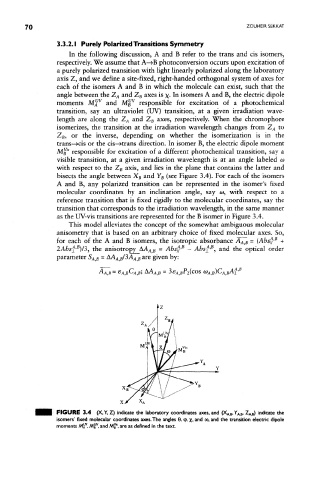
                 each of the isomers A and B in which the molecule can exist, such that the
                 angle between the Z A and Z B axes is x- In isomers A and B, the electric dipole
                             V         V
                 moments M A  and M B  responsible for excitation of a photochemical
                 transition, say an ultraviolet (UV) transition, at a given irradiation wave-
                 length are along the Z A and Z B axes, respectively. When the chrornophore
                 isomerizes, the transition at the irradiation wavelength changes from Z A to
                 Z B, or the inverse, depending on whether the isomerization is in the
                 trans-»cis or the cis— Hrans direction. In isomer B, the electric dipole moment
                    S
                 MB'  responsible for excitation of a different photochemical transition, say a
                 visible transition, at a given irradiation wavelength is at an angle labeled ca
                 with respect to the Z B axis, and lies in the plane that contains the latter and
                 bisects the angle between X B and Y B (see Figure 3.4). For each of the isomers
                 A and B, any polarized transition can be represented in the isomer's fixed
                 molecular coordinates by an inclination angle, say w, with respect to a
                 reference transition that is fixed rigidly to the molecular coordinates, say the
                 transition that corresponds to the irradiation wavelength, in the same manner
                 as the UV-vis transitions are represented for the B isomer in Figure 3.4.
                     This model alleviates the concept of the somewhat ambiguous molecular
                 anisornetry that is based on an arbitrary choice of fixed molecular axes. So,
                                                                                 B
                 for each of the A and B isomers, the isotropic absorbance A AfB ~ (Absf'  +
                                                     E
                                                               >B
                      B
                 2Absf' }/3, the anisotropy_AA^ )S = Absf}'  - Abs± , and the optical order
                 parameter S AjB = AA A)B/3 A A B are given by:


                 FIGURE 3.4  (X, Y, Z) indicate the laboratory coordinates axes, and (X A B, Y A B, Z^ B) indicate the
                 isomers' fixed molecular coordinates axes. The angles 0, <p, x> and o>, and the transition electric dtpole
                 moments Al^, M^, and Mjf*. are as defined in the text.

