


Page 95 - Photoreactive Organic Thin Films
P. 95
74                                                                ZOUHEIR SEKK.AI

                                   2)     = (« + !)(« + 2)   ,   =    *(«-!)
                                      ' "                 J    w "
                 This system of equations shows, through even orders, that polarized light
                 irradiation creates anisotropy and photo-orientation by photoisomerization.
                 A solution to the time evolution of the cis and trans expansion parameters
                 cannot be found without approximations; this is when physics comes into
                 play. Approximate numerical simulations are possible. I will show that for
                 detailed and precise comparison of experimental data with the photo-
                 orientation theory, it is not necessary to have a solution for the dynamics,
                 even in the most general case where there is not enough room for
                 approximations, i.e., that of push-pull azo dyes, such as DR1, because of the
                 strong overlap of the linear absorption spectra of the cis and trans isomers of
                 such chromophores. Rigorous analytical expressions of the steady-state
                 behavior and the early time evolution provide the necessary tool for a full
                 characterization of photo-orientation by photoisomerization.
                 3.3.2.3 Dynamical Behavior of Photo-Orientation
                    3.3.2.3. / Onset of Photo-Orientation
                    The purpose of this section is to give an approximate analytical
                 expression that reproduces the dynamics of anisotropy during photo-
                 orientation. The experimentally observed evolution of photo-orientation
                 when only one isomer is photoisomerized as well as when the two isomers
                 are simultaneously photoisomerized presents a characteristic behavior that
                 can be approximated by a double-exponential function. To solve analytically
                 the system of Equation 3.9, I shall introduce approximations that are
                 physically valid for at least the azobenzene molecule in a polymeric environ-
                 ment, and I shall neglect the expansion parameters above the third order. The
                 fourth Legendre polynomial moment is a small correction to the second
                 Legendre polynomial moment, which gives the anisotropy. I have assumed
                 that only the trans isomer significantly absorbs the irradiation light, i.e., the
                 pump light, and that the rates of both the cis— »trans thermal isomerization
                 and the diffusion in the cis and trans forms are small. Analytical solutions are
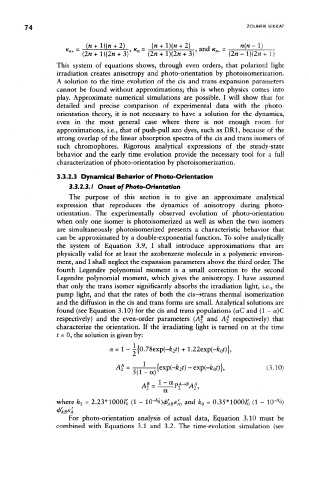
                 found (see Equation 3.10) for the cis and trans populations (aC and (1 - a)C
                 respectively) and the even-order parameters (Af and Af respectively) that
                 characterize the orientation. If the irradiating light is turned on at the time
                 t = 0, the solution is given by:

                                a = 1 - |{0.78exp(-fc 2f) + 1.22exp(-M},

                                    A
                                         1
                                  A 2  =  5(1 _ a)(exp(-M - exp(-V)},         (3.10)
                                          A$ = LL°LP}-+*A},

                                                                                 A
                 where k 2 = 2.23*1000/0 (1 - lO^o)^**, and k 0 = 0.35*10001^ (1 - lQr 'o)
                    For photo-orientation analysis of actual data, Equation 3.10 must be
                 combined with Equations 3.1 and 3.2. The time-evolution simulation (see

